
Adding Fractions with Common Denominators by Jan Elemans
Loading the math board and drawing, please wait…
In collections
Module 2: Fractions
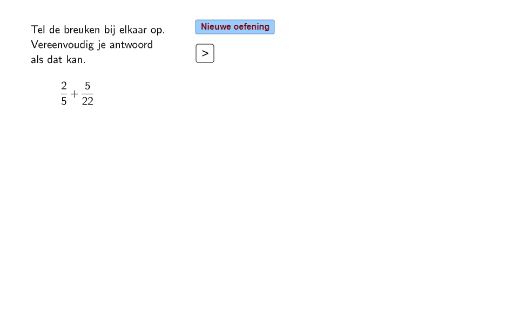
This example demonstrates the addition of fractions with common denominators. It involves the core mathematical concept of fraction arithmetic. Using GeoGebra commands such as Random, GCD, and Div, the process of fraction addition is dynamically illustrated. Suitable for high-grade elementary or junior high school students learning fraction addition.
GeoGebra Commands & Parameters
Random(1, 9) → aRandom(10, 20) → bGCD(a, b) → cRandom(1, 9) → fRandom(11, 25) → gGCD(f, g) → hGCD(o, l) → pDiv(q, r) → tIf(q > r, true, false) → v
AI Drawing Prompt Reference
Draw the process of adding two fractions with a common denominator. First, randomly generate two numerators a and b with a common denominator c, which is their greatest common divisor. Then, generate two new numerators f and g with a common denominator h, which is their greatest common divisor. Next, calculate the sum of the two numerators and determine if the order needs to be adjusted to ensure the first fraction's numerator is greater than the second fraction's numerator.
The prompt above was compiled from the original drawing commands and is for reference only.