
Negative Dilation Triangle
Loading the math board and drawing, please wait…
In collections
Dilations
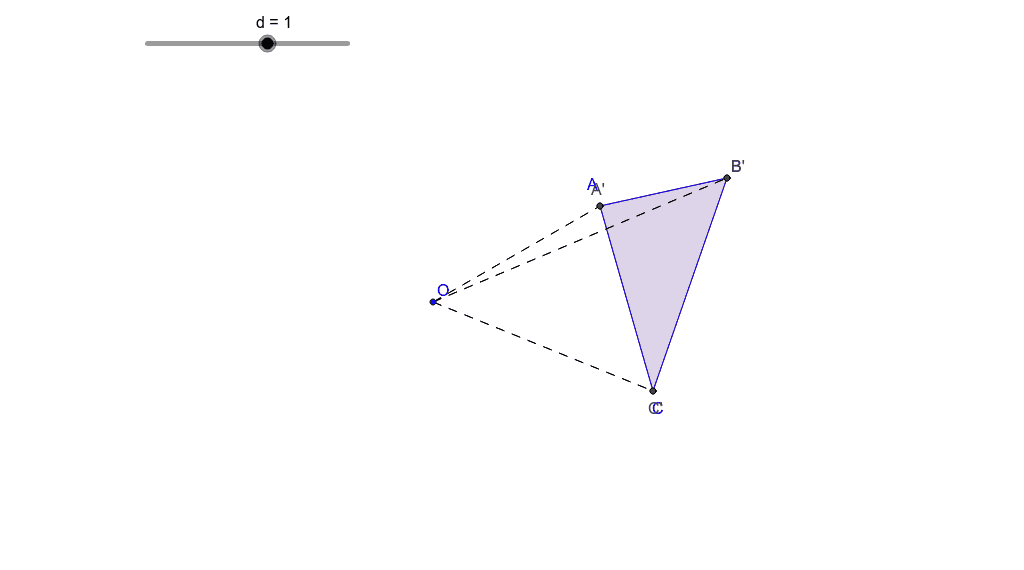
This example demonstrates the effect of negative dilation on a triangle, dynamically showing the relationship between the original and transformed triangle. Core math concepts include geometric transformations, coordinate geometry, and area changes of triangles. Construction highlights involve commands like Polygon, Intersect, and Segment in GeoGebra. Suitable for high school mathematics teaching to understand the properties and applications of geometric transformations.
GeoGebra Commands & Parameters
Polygon(Dilate[A, d, O], Dilate[B, d, O], Dilate[C, d, O]) → poly1, a, b, cPolygon(C, A, B) → poly2, b_1, c_1, a_1Intersect(a, c) → A'Intersect(a, b) → B'Intersect(b, c) → C'Segment(O, A) → eSegment(O, B) → fSegment(O, C) → gSegment(O, A') → hSegment(O, B') → iSegment(O, C') → j
AI Drawing Prompt Reference
Draw a triangle and then dilate it negatively with respect to a point to show the transformed triangle, connecting the original and dilated vertices to the center of dilation to illustrate the transformation.
The prompt above was compiled from the original drawing commands and is for reference only.