
Nautilus Shell by Daniel Mentrard
Loading the math board and drawing, please wait…
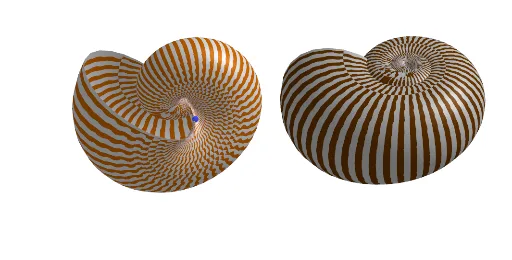
This example demonstrates the generation of a nautilus shell. Key mathematical concepts include geometric mean, differential equations, and complex numbers. Using GeoGebra commands such as Surface and objects A, B, d, b, c, a, C, f, D, E, image1, F, G, image2, dx, e, g, the construction of a nautilus shell is achieved. Suitable for high school mathematics education and research.
GeoGebra Commands & Parameters
Surface(((1.16^(v) * cos(v)) * (1 + cos(u))), (((-1.16^(v)) * sin(v)) * (1 + cos(u))), ((-1.16^(v)) * (1 + sin(u))) + d, u, 0, 6.28319, v, (-b), c) → aSurface(x(C) + ((1.16^(v) * cos(v)) * (1 + cos(u))), y(C) + ((-1.16^(v)) * (1 + sin(u))) + d, z(C) + (((-1.16^(v)) * sin(v)) * (1 + cos(u))), u, 0, 6.28319, v, (-b), c) → fSurface(((1.16^(v) * cos(v)) * (1 + cos(u))), (((-1.16^(v)) * sin(v)) * (1 + cos(u))), ((-1.16^(v)) * (1 + sin(u))) + d, u, 0, 6.28319, v, (-b) + dx, c - dx) → eSurface(x(C) + ((1.16^(v) * cos(v)) * (1 + cos(u))), y(C) - (1.16^(v) * (1 + sin(u))) + d, z(C) - ((1.16^(v) * sin(v)) * (1 + cos(u))), u, 0, 6.28319, v, (-b) + dx, c - dx) → g