
Multipurpose Number (0-20) Generators
Loading the math board and drawing, please wait…
In collections
Elementary Math Resources
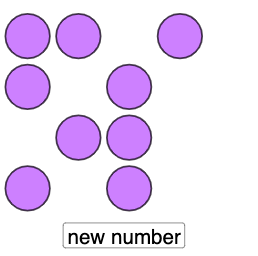
This example demonstrates how to generate numbers from 0 to 20 and construct geometric figures using GeoGebra. It involves core mathematical concepts such as addition, subtraction, function graphs, complex numbers, statistics, upper and lower sums or Riemann sums, and geometric constructions. Key GeoGebra commands and objects used include Polygon, Segment, Circle, Translate, and Sequence. It is suitable for high school mathematics teaching, illustrating the construction of functions, geometric transformations, and statistical charts.
GeoGebra Commands & Parameters
Polygon((0, 0), (10, 0), (10, 4), (0, 4)) → q1, f, g_{1}, h, iSegment((0, 2), (10, 2)) → jCircle(G, 7 / 8) → rCircle(C, 7 / 8) → eCircle(B, 7 / 8) → dCircle(A, 7 / 8) → cCircle(F, 7 / 8) → qCircle(H, 7 / 8) → sCircle(I, 7 / 8) → tCircle(J, 7 / 8) → c_1Circle(D, 7 / 8) → kCircle(E, 7 / 8) → pTranslate(f, Vector[(0, -2)]) → f'Translate(f, Vector[(0, -4)]) → f'_{1}Circle(K, 7 / 8) → d_1Circle(L, 7 / 8) → e_1Circle(M, 7 / 8) → f_1Circle(N, 7 / 8) → h_1Circle(O, 7 / 8) → k_1Circle(P, 7 / 8) → p_1Circle(Q, 7 / 8) → q_1Circle(R, 7 / 8) → r_1Circle(S, 7 / 8) → s_1Circle(T, 7 / 8) → t_1Sequence(Segment[(2 + i, -4), (2 + i, 0)], i, -2, 8, 2) → l2, {4, 4, 4, 4, 4, 4}Sequence(Segment[(2 + i, 0), (2 + i, 4)], i, -2, 8, 2) → l1, {4, 4, 4, 4, 4, 4}Sequence(Random[0, 1] + (0 * i), i, 1, 20, 1) → l3, {1, 1, 0, 1, 0, 1, 0, 1, 0, 0, 0, 1, 1, 0, 0, 1, 0, 1, 0, 0}
AI Drawing Prompt Reference
First draw a rectangle with vertices (0,0), (10,0), (10,4), (0,4). Then construct a horizontal segment from (0,2) to (10,2). Inside (or around) this region, take several predetermined centers and draw multiple circles all with the same radius 7/8. Next, translate some of these circles vertically: shift one circle downward by 2 units and also create another shifted downward by 4 units. Finally, generate sets of equal-length vertical segment pieces along the line x = 2 + i, for i ranging over a given integer interval, producing a sequence-like arrangement of segments for number/function generation.
The prompt above was compiled from the original drawing commands and is for reference only.