
Multiplying Binomial Expressions Geometrically
Loading the math board and drawing, please wait…
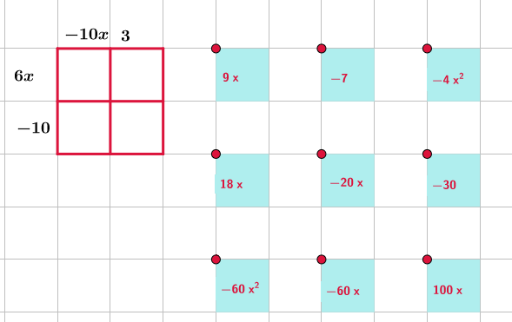
This example demonstrates the process of multiplying binomials geometrically. Key mathematical concepts include polynomial multiplication and geometric representation. Using GeoGebra commands such as Segment, RandomElement, and Polynomial, the process of multiplication is dynamically shown. Suitable for students in middle school and above to learn polynomial multiplication and geometric representation.
GeoGebra Commands & Parameters
Segment(A, C) → fSegment(A, F) → gSegment(F, H) → hSegment(C, H) → iSegment(B, G) → jSegment(D, E) → kRandomElement(list1) → mRandomElement(list2) → nRandomElement(list3) → uRandomElement(list4) → vPolynomial((m * x) + u) → pPolynomial((n * x) + v) → qPolynomial((p(x) * q(x))) → rPolynomial(((m * x) * (n * x))) → sPolynomial(((n * x) * u)) → tPolynomial(((m * x) * v)) → f_1Polynomial((u * v)) → g_1Polynomial(((m + n) * x^(2))) → h_1Polynomial(((m + v) * x)) → p_1Polynomial(((n + u) * x)) → q_1Polynomial(u + v) → r_1Polynomial(((m * n) * x)) → s_1Intersect(g, h) → IIntersect(h, j) → JIntersect(j, k) → KIntersect(g, k) → LDistance(I, J) → distanceIJPoint(Circle[M, 2]) → NSegment(M, N) → lOrthogonalLine(M, l) → bOrthogonalLine(N, l) → cDistance(M, b) → distanceMbPoint(Circle[M, 2]) → OSegment(M, O) → dRotate(M, 270°, M) → M'Rotate(O, 270°, M) → O'Segment(M', O') → d'OrthogonalLine(O', d') → eIntersect(c, e) → PPolygon(M, N, P, O') → poly1, m_1, n_1, p_2, o'Distance(M, N) → distanceMNPoint(Circle[Q, 2]) → RSegment(Q, R) → i_1Rotate(Q, 270°, Q) → Q'Rotate(R, 270°, Q) → R'Segment(Q', R') → j_1OrthogonalLine(R', j_1) → k_1OrthogonalLine(R, i_1) → l_1Intersect(k_1, l_1) → SPolygon(Q, R, S, R') → poly2, q_2, r_2, s_2, r'Distance(Q, R) → distanceQRPoint(Circle[T, 2]) → USegment(T, U) → t_1Rotate(T, 270°, T) → T'Rotate(U, 270°, T) → U'Segment(T', U') → c_8OrthogonalLine(U', c_8) → e_1OrthogonalLine(U, t_1) → f_2Intersect(e_1, f_2) → VPolygon(T, U, V, U') → poly3, t_2, u_1, v_1, u'Distance(T, U) → distanceTUPoint(Circle[W, 2]) → ZSegment(W, Z) → g_2Rotate(W, 270°, W) → W'Rotate(Z, 270°, W) → Z'Segment(W', Z') → h_2OrthogonalLine(Z', h_2) → i_2OrthogonalLine(Z, g_2) → j_2Intersect(i_2, j_2) → A_1Polygon(W, Z, A_1, Z') → poly4, w, z_1, a_3, z'Distance(W, Z) → distanceWZPoint(Circle[B_1, 2]) → C_1Segment(B_1, C_1) → k_2Rotate(B_1, 270°, B_1) → D_1Rotate(C_1, 270°, B_1) → E_1Segment(D_1, E_1) → l_2OrthogonalLine(E_1, l_2) → m_2OrthogonalLine(C_1, k_2) → n_2Intersect(m_2, n_2) → F_1Polygon(B_1, C_1, F_1, E_1) → poly5, b_3, c_2, f_3, e_2Distance(B_1, C_1) → distanceB1C1Point(Circle[G_1, 2]) → H_1Segment(G_1, H_1) → g_3Rotate(G_1, 270°, G_1) → I_1Rotate(H_1, 270°, G_1) → J_1Segment(I_1, J_1) → h_3OrthogonalLine(J_1, h_3) → i_3OrthogonalLine(H_1, g_3) → j_3Intersect(i_3, j_3) → K_1Polygon(G_1, H_1, K_1, J_1) → poly6, g_4, h_4, k_3, j_4Distance(G_1, H_1) → distanceG1H1Point(Circle[L_1, 2]) → M_1Segment(L_1, M_1) → l_3Rotate(L_1, 270°, L_1) → N_1Rotate(M_1, 270°, L_1) → O_1Segment(N_1, O_1) → m_3OrthogonalLine(O_1, m_3) → n_3OrthogonalLine(M_1, l_3) → p_3Intersect(n_3, p_3) → P_1Polygon(L_1, M_1, P_1, O_1) → poly7, l_4, m_4, p_4, o_1Distance(L_1, M_1) → distanceL1M1Point(Circle[Q_1, 2]) → R_1Segment(Q_1, R_1) → q_3Rotate(Q_1, 270°, Q_1) → S_1Rotate(R_1, 270°, Q_1) → T_1Segment(S_1, T_1) → r_3OrthogonalLine(T_1, r_3) → s_3OrthogonalLine(R_1, q_3) → t_3Intersect(s_3, t_3) → U_1Polygon(Q_1, R_1, U_1, T_1) → poly8, q_4, r_4, u_2, t_4Distance(Q_1, R_1) → distanceQ1R1Point(Circle[V_1, 2]) → W_1Segment(V_1, W_1) → c_3Rotate(V_1, 270°, V_1) → Z_1Rotate(W_1, 270°, V_1) → A_2Segment(Z_1, A_2) → d_3OrthogonalLine(A_2, d_3) → e_3OrthogonalLine(W_1, c_3) → f_4Intersect(e_3, f_4) → B_2Polygon(V_1, W_1, B_2, A_2) → poly9, v_2, w_1, b_4, a_4Distance(V_1, W_1) → distanceV1W1Polynomial((p(x) * v)) → f_5Polynomial(((p(x) * n) * x)) → s_4Polynomial(s_4(x) + f_5(x)) → g_5Polynomial(((m * x) * q(x))) → h_5Polynomial((u * q(x))) → p_5Polynomial(h_5(x) + p_5(x)) → q_5