
Multiplication Table Triangle
Loading the math board and drawing, please wait…
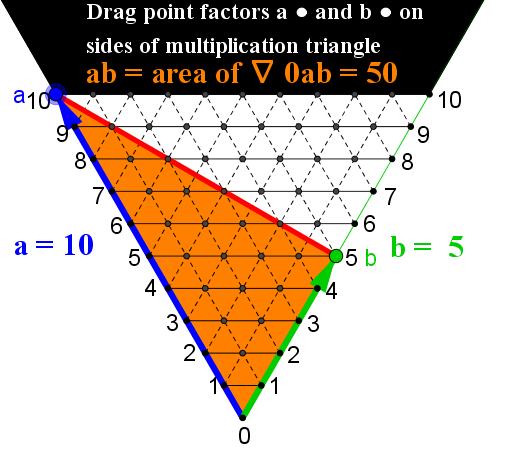
This example demonstrates how to construct a multiplication table triangle using GeoGebra, visually integrating multiplication with geometric shapes. Core math concepts include multiplication, triangles, vectors, rotation, etc. Construction involves commands/objects like Point, Intersect, Ray, Circle, Rotate, Angle, Segment, Line, Polygon, Vector as per the summary. Suitable for middle school and above to explore geometric constructions and mathematical visualization, particularly the geometric properties of multiplication tables.
GeoGebra Commands & Parameters
Point(xAxis) → BIntersect(xAxis, yAxis) → ARay(A, B) → fPoint(f) → DCircle(A, D) → dRotate(B, 60°, A) → B'Ray(A, B') → gIntersect(d, g, 1) → OCircle(A, C) → cIntersect(c, g, 1) → RCircle(A, E) → eIntersect(e, g, 1) → ICircle(A, F) → hIntersect(h, g, 1) → JCircle(A, G) → kIntersect(k, g, 1) → NCircle(A, W) → c_1Intersect(c_1, g, 1) → D_1Circle(A, Z) → d_1Intersect(d_1, g, 1) → E_1Circle(A, A_1) → e_1Intersect(e_1, g, 1) → F_1Circle(A, B_1) → k_1Intersect(k_1, g, 1) → G_1Circle(A, C_1) → p_1Intersect(p_1, g, 1) → H_1Rotate(A, (-(60°)), B') → A'_3Ray(A, A'_3) → iIntersect(c_1, i, 1) → M_1Intersect(p_1, i, 1) → L_1Intersect(k_1, i, 1) → K_1Intersect(e_1, i, 1) → J_1Intersect(d_1, i) → I_1,Intersect(c, i, 1) → QIntersect(k, i, 1) → MIntersect(e, i, 1) → LIntersect(h, i, 1) → KIntersect(d, i, 1) → PAngle(B, A, B') → βRotate(A, 60°, B') → A'_2Angle(A, B', A'_2) → ζAngle(A'_3, B', A) → ηCircle(A, H) → pSegment(M, N) → jSegment(K, J) → lSegment(L, I) → mSegment(P, O) → nSegment(Q, R) → qLine(R, i) → rIntersect(r, j) → SRay(R, S) → sLine(O, s) → tLine(I, t) → a_9Intersect(n, s) → TRay(Q, T) → b_7Intersect(a_9, j) → URay(P, U) → f_1Intersect(t, j) → VRay(L, V) → g_1Ray(I, U) → h_1Ray(O, V) → i_1Segment(I_1, E_1) → j_1Segment(F_1, J_1) → l_1Segment(K_1, G_1) → m_1Segment(L_1, H_1) → n_1Segment(M_1, D_1) → q_1Intersect(s, q_1) → N_1Intersect(s, j_1) → O_1Intersect(s, l_1) → P_1Intersect(s, m_1) → Q_1Intersect(s, n_1) → R_1Intersect(j, b_7) → S_1Intersect(b_7, q_1) → T_1Intersect(b_7, j_1) → U_1Intersect(b_7, l_1) → V_1Intersect(b_7, m_1) → W_1Intersect(b_7, n_1) → Z_1Ray(J, S_1) → r_1Ray(N, T_1) → s_1Ray(D_1, U_1) → t_1Ray(E_1, V_1) → a_1Ray(F_1, W_1) → b_1Ray(G_1, Z_1) → f_2Ray(K, S) → g_2Ray(M, N_1) → h_2Ray(M_1, O_1) → i_2Ray(I_1, P_1) → j_2Ray(J_1, Q_1) → k_2Ray(K_1, R_1) → l_2Intersect(l, s) → A_2Intersect(l, f_1) → B_2Intersect(l, b_7) → C_2Intersect(m, b_7) → D_2Intersect(m, s) → E_2Intersect(n, s) → F_2Intersect(g_1, h_1) → G_2Intersect(f_1, s_1) → H_2Intersect(g_1, j_1) → I_2Intersect(h_1, j_1) → J_2Intersect(i_1, j_1) → K_2Intersect(i_1, i_2) → L_2Intersect(r_1, g_2) → M_2Intersect(g_1, l_1) → N_2Intersect(f_1, t_1) → O_2Intersect(f_1, r_1) → P_2Intersect(i_1, q_1) → Q_2Intersect(i_1, n_1) → R_2Intersect(h_1, n_1) → S_2Intersect(n_1, s_1) → T_2Intersect(f_1, n_1) → U_2Intersect(g_1, n_1) → V_2Intersect(n_1, t_1) → W_2Intersect(n_1, r_1) → Z_2Intersect(i_1, m_1) → A_3Intersect(m_1, r_1) → B_3Intersect(f_1, m_1) → C_3Intersect(g_1, m_1) → D_3Intersect(m_1, s_1) → E_3Intersect(h_1, l_1) → F_3Circle(A, G_3) → c_2Circle(A, H_3) → d_2Circle(A, I_3) → e_2Circle(A, J_3) → p_2Circle(A, K_3) → q_2Circle(A, L_3) → r_2Circle(A, M_3) → s_2Circle(A, N_3) → t_2Circle(A, O_3) → c_3Circle(A, P_3) → d_3Segment(R, P) → m_2Segment(R, L) → n_2Segment(R, K) → a_2Segment(R, M) → b_2Segment(R, M_1) → f_3Segment(R, I_1) → g_3Segment(R, K_1) → h_3Segment(R, J_1) → i_3Segment(R, L_1) → j_3Segment(Q, D_1) → k_3Segment(Q, E_1) → l_3Segment(Q, O) → m_3Segment(Q, I) → n_3Segment(Q, J) → p_3Segment(Q, N) → q_3Segment(Q, H_1) → r_3Segment(Q, F_1) → s_3Segment(Q, G_1) → t_3Segment(P, I) → a_3Segment(P, J) → b_3Segment(P, D_1) → e_3Segment(P, N) → f_4Segment(P, F_1) → g_4Segment(P, E_1) → h_4Segment(P, G_1) → i_4Segment(P, H_1) → j_4Segment(L, J) → k_4Segment(L, N) → l_4Segment(L, D_1) → m_4Segment(L, E_1) → n_4Segment(L, F_1) → p_4Segment(L, G_1) → q_4Segment(L, H_1) → r_4Segment(O, L) → s_4Segment(K, O) → t_4Segment(M, O) → a_4Segment(M_1, O) → b_4Segment(I_1, O) → c_4Segment(O, J_1) → d_4Segment(O, K_1) → e_4Segment(O, L_1) → f_5Segment(I, K) → g_5Segment(I, M) → h_5Segment(M_1, I) → i_5Segment(I_1, I) → j_5Segment(J_1, I) → k_5Segment(K_1, I) → l_5Segment(L_1, I) → m_5Segment(J, M) → n_5Segment(M_1, J) → p_5Segment(J, I_1) → q_5Segment(J, J_1) → r_5Segment(J, K_1) → s_5Segment(L_1, J) → t_5Segment(K, H_1) → a_5Segment(G_1, K) → b_5Segment(F_1, K) → c_5Segment(E_1, K) → d_5Segment(D_1, K) → e_5Segment(N, K) → f_6Segment(M, H_1) → g_6Segment(M, D_1) → h_6Segment(M, E_1) → i_6Segment(M, F_1) → j_6Segment(M, G_1) → k_6Segment(N, M_1) → l_6Segment(N, I_1) → m_6Segment(N, J_1) → n_6Segment(N, K_1) → p_6Segment(N, L_1) → q_6Segment(M_1, E_1) → r_6Segment(M_1, F_1) → s_6Segment(M_1, G_1) → t_6Segment(M_1, H_1) → a_6Segment(D_1, L_1) → b_6Segment(D_1, K_1) → c_6Segment(D_1, J_1) → d_6Segment(D_1, I_1) → e_6Segment(I_1, F_1) → f_7Segment(I_1, G_1) → g_7Segment(I_1, H_1) → h_7Segment(E_1, J_1) → i_7Segment(E_1, K_1) → j_7Segment(E_1, L_1) → k_7Segment(J_1, G_1) → l_7Segment(J_1, H_1) → m_7Segment(F_1, K_1) → n_7Segment(L_1, F_1) → p_7Segment(G_1, L_1) → q_7Segment(K_1, H_1) → r_7Intersect(h_1, m_1) → Q_3Point(L_a) → aSegment(a, A) → s_7Point(L_b) → bSegment(A, b) → t_7Segment(a, b) → a_7Polygon(A, a, b) → poly1, s_8, a_8, r_8Vector(A, a) → uVector(A, b) → vPoint(i) → R_3Point(g) → S_3Point(i) → T_3Point(g) → U_3Polygon(T_3, U_3, H_1, L_1) → poly2, t_8, u_3, h_8, l_8