
Indian Logic Meets Descartes' Multiplication Model
Loading the math board and drawing, please wait…
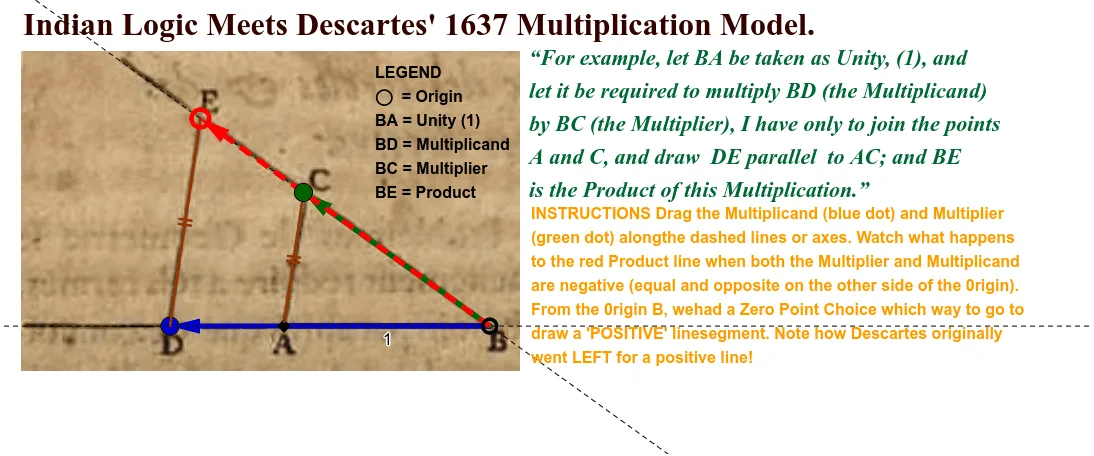
This example demonstrates the integration of Indian logic with Descartes' multiplication model, visualizing the geometric meaning of multiplication operations. Core math concepts include multiplication, power functions, difference and slope, area, reflection, and similarity transformation. It is constructed using GeoGebra commands/objects like Intersect, Line, Point, Ray, Segment, Vector, and Circle as outlined in the construction summary. Suitable for high school and above, it helps learners understand the connection between algebra and geometry, deepening the comprehension of the essence of multiplication.
GeoGebra Commands & Parameters
Intersect(xAxis, yAxis) → BLine(U, B) → sPoint(xAxis) → APoint(xAxis) → DRay(B, K) → lPoint(s) → LSegment(B, A) → UnitSegment(B, D) → aSegment(B, C) → bLine(B, C) → cSegment(A, C) → eLine(A, e) → fLine(D, f) → gIntersect(g, c) → ESegment(B, E) → abSegment(A, C) → iSegment(D, E) → jSegment(B, A) → hLine(B, D) → dVector(B, D) → uPoint(c) → FPoint(c) → GPoint(c) → HPoint(d) → IRay(B, D) → kCircle(A, L, D) → rPoint(s) → TLine(T, A) → tPoint(s) → JVector(T, J) → u_1Point(t) → PSegment(P, J) → ACLine(D, AC) → nIntersect(s, n) → VVector(T, V) → wSegment(V, D) → DE