
Multiplication and Statistics Experiment
Loading the math board and drawing, please wait…
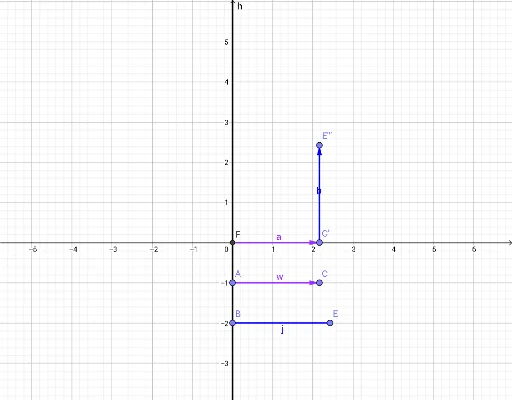
This example demonstrates multiplication and statistical experiments using GeoGebra, focusing on how to calculate upper and lower sums or Riemann sums, and confidence intervals through random experiments. Core mathematical concepts include multiplication, statistics, random experiments, upper and lower sums, Riemann sums, confidence intervals, and rational numbers. Construction highlights involve commands and objects like Point, OrthogonalLine, Line, Segment, Intersect, Rotate, Vector, Translate, Circle. Suitable for high school mathematics education to understand the concepts of Riemann sums and confidence intervals in calculus.
GeoGebra Commands & Parameters
Point(yAxis) → APoint(yAxis) → BOrthogonalLine(A, yAxis) → fOrthogonalLine(B, yAxis) → gLine(B, A) → hPoint(f) → COrthogonalLine(C, f) → iPoint(g) → ESegment(B, E) → jIntersect(h, xAxis) → FRotate(E, 90°, B) → E'Vector(B, F) → uTranslate(E', u) → E''Segment(A, C) → kIntersect(i, xAxis) → DVector(C, D) → vTranslate(C, v) → C'OrthogonalLine(E'', h) → lVector(A, C) → wTranslate(E'', w) → E'''Vector(F, C') → aVector(C', E''') → bCircle(C', F) → cIntersect(h, yAxis) → H