
Multiplication and Division of Complex Numbers in Modulus-Argument Form
Loading the math board and drawing, please wait…
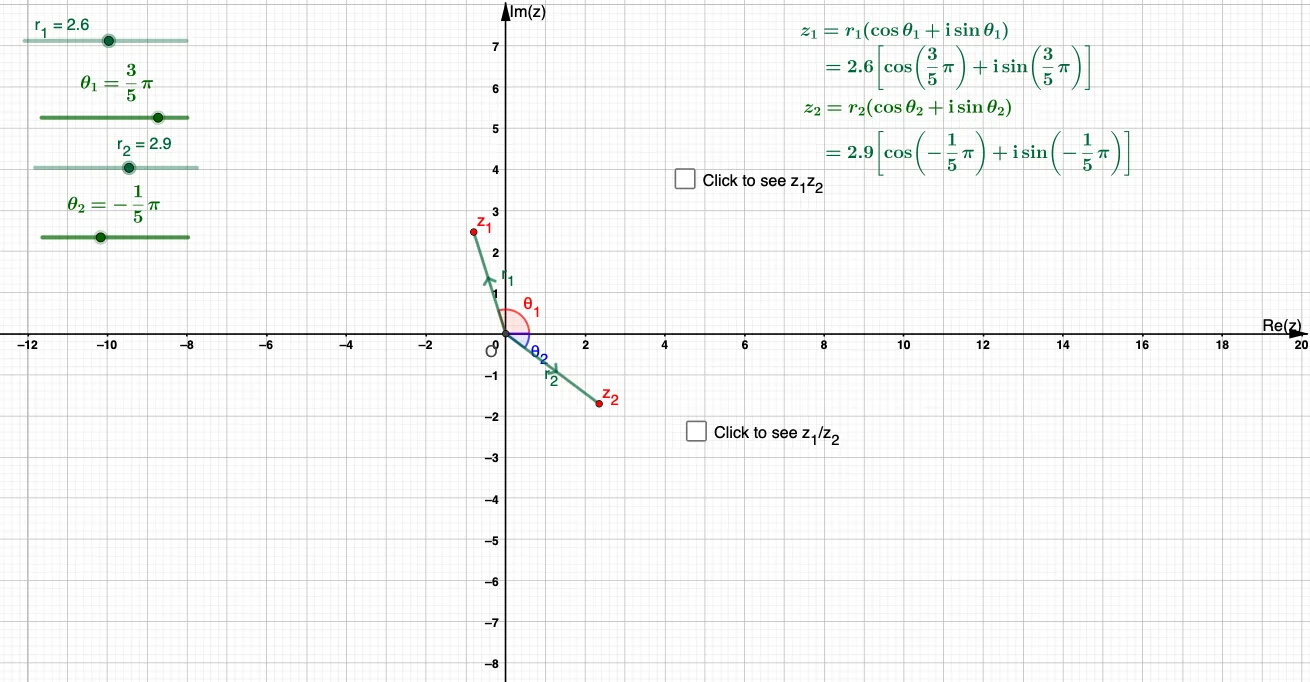
This GeoGebra example dynamically visualizes the rules for multiplying and dividing complex numbers in modulus-argument (polar) form. The core mathematical concept is the trigonometric representation of complex numbers: when multiplying, moduli are multiplied and arguments are added; when dividing, moduli are divided and arguments are subtracted. The construction uses commands such as Intersect to create intersection points, Segment for line segments, Angle to mark arguments, SurdText and FractionText to display exact radical and fractional results, and If for conditional logic. Key objects include parameters r_1, θ_1, r_2, θ_2, and complex points z_1, z_2, z_3, z_4, allowing users to adjust moduli and arguments via sliders or inputs to observe the geometric positions of products and quotients. Suitable for high school or early university students learning complex number operations, and for teachers demonstrating the geometric meaning of complex multiplication and division in polar coordinates.
GeoGebra Commands & Parameters
Intersect(xAxis, yAxis) → OSegment(O, z_1) → fAngle((3, 0), O, z_1, xAxis) → αSegment(O, z_2) → gAngle((3, 0), O, z_2, xAxis) → βSegment(O, z_3) → hAngle((3, 0), O, z_3) → ζSegment(O, z_4) → iAngle((3, 0), O, z_4) → θSurdText(r_1) → text13If(θ_2 < 0, "-", "+") → multFractionText(abs(θ_2) / pi) → Newtext_{1}If(θ_2 < 0, "+", "-") → divIf(θ_2 < 0, "-", "") → text18FractionText(abs(θ_1) / pi) → text19If(θ_1 < 0, "-", "") → text20FractionText(abs(α_1) / pi) → text21FractionText(κ) → absmultIf(ε < 0, "-", "") → signmultFractionText(abs(η) / pi) → absdivIf(η < 0, "-", "") → signdiv
AI Drawing Prompt Reference
Create a dynamic visualization showing multiplication and division rules for complex numbers in polar form. Display two complex numbers as line segments from the origin with their moduli and arguments marked. Adjust the moduli and arguments using sliders to show the geometric positions of their product and quotient. The product's modulus is the product of the moduli, and its argument is the sum of the arguments. The quotient's modulus is the quotient of the moduli, and its argument is the difference of the arguments. Label the moduli and arguments, and indicate the sign of the arguments.
The prompt above was compiled from the original drawing commands and is for reference only.