
Multiple Normal Vectors of Parametric Curves
Loading the math board and drawing, please wait…
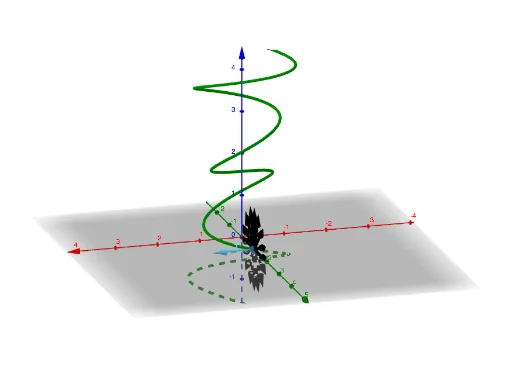
This GeoGebra example demonstrates how to draw parametric curves using the CurveCartesian command and display normal vectors at various points using the Vector command. Multiple adjustable vector objects (u, v, w, etc.) intuitively show the direction and distribution of normal vectors along the curves. Key mathematical concepts involved include parametric equations, vector operations, the perpendicular relationship between curve tangents and normals, and coordinate transformations. Construction details: Use CurveCartesian to generate parametric curve loci, apply Vector to construct normal vectors at specified points, and control the number, position, and length of normal vectors through variables a through n. Suitable for high school or pre-university mathematics courses teaching vectors and analytic geometry, serving as an interactive teaching tool for learning parametric curve normal vector concepts.
GeoGebra Commands & Parameters
CurveCartesian(sin((4 * t)), cos((3 * t)), t, t, (-2 * π), (2 * π)) → aVector((0, 1, 0), (0, 2, 0)) → uVector((0, 1, 0), (0, 1, 1)) → vVector((0, 1, 0), (0, 0, 0)) → wVector((0, 1, 0), (0, 1, -1)) → bVector((0, 1, 0), (0, 1 + 1 / sqrt(2), 1 / sqrt(2))) → cVector((0, 1, 0), (0, 1 - 1 / sqrt(2), 1 / sqrt(2))) → dVector((0, 1, 0), (0, 1 - 1 / sqrt(2), (-1) / sqrt(2))) → eVector((0, 1, 0), (0, 1 + 1 / sqrt(2), (-1) / sqrt(2))) → fVector((0, 1, 0), (0, 1 + 1 / 3, sqrt(8) / 3)) → gVector((0, 1, 0), (0, 1 - 1 / 3, sqrt(8) / 3)) → hVector((0, 1, 0), (0, 1 + 1 / 3, ((-sqrt(8))) / 3)) → iVector((0, 1, 0), (0, 1 - 1 / 3, ((-sqrt(8))) / 3)) → jVector((0, 1, 0), (0, 1 + sqrt(8) / 3, 1 / 3)) → kVector((0, 1, 0), (0, 1 - sqrt(8) / 3, 1 / 3)) → lVector((0, 1, 0), (0, 1 + sqrt(8) / 3, (-1) / 3)) → mVector((0, 1, 0), (0, 1 - sqrt(8) / 3, (-1) / 3)) → nVector((0, 1, 0), (1, 1, 0)) → T