
Movement around the Sun: Gravity-Driven Orbital Simulation
Loading the math board and drawing, please wait…
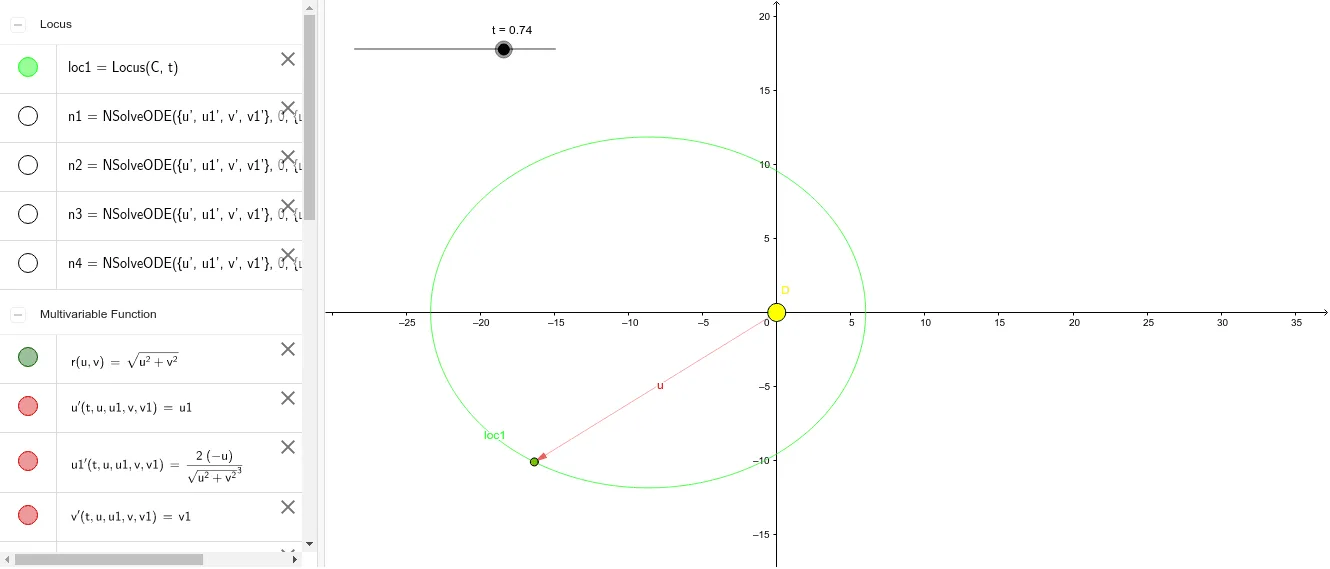
This GeoGebra example simulates the motion of a planet around the Sun under gravitational attraction, demonstrating how the law of gravity shapes orbital paths. It visually presents the solution of Newton's equations of motion as a differential equation system. Core mathematical concepts include ordinary differential equations (ODEs), vector calculus, numerical integration via NSolveODE, and the geometric locus of the moving point. The construction uses commands such as NSolveODE to solve the motion equations, Length to compute vector magnitudes, Point and Locus to trace the orbit, and Vector to display velocity or force directions. Suitable for high school physics or university mechanics courses, this example helps students understand celestial motion, numerical methods for ODEs, and vector-based geometric modeling.
GeoGebra Commands & Parameters
NSolveODE({u', u1', v', v1'}, 0, {u_0, u1_0, v_0, v1_0}, T) → n1, n2, n3, n4Length(n1) → lenPoint(n1, t) → APoint(n3, t) → BLocus(C, t) → loc1Point(n3) → DVector(D, C) → u
AI Drawing Prompt Reference
Simulate a planet orbiting the Sun under gravitational attraction to show how gravity shapes orbital paths. Use numerical solutions of differential equations to visualize the planet's motion path as a geometric locus, and display velocity or force directions with vectors.
The prompt above was compiled from the original drawing commands and is for reference only.