
Beads on a String Vibrations
Loading the math board and drawing, please wait…
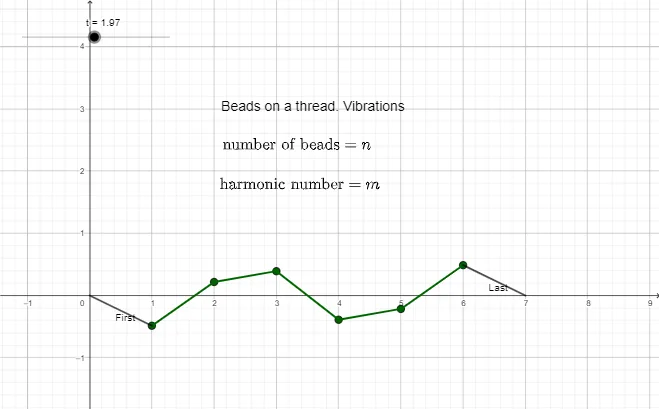
This example demonstrates the vibrations of beads on a string. It involves core mathematical concepts such as differential equations, vectors, normal distribution, and quadratic equations. The construction uses GeoGebra commands like Sequence and Segment, along with objects like Amplit (amplitude), m (mass), t (time), n (number of beads), λ (wavelength), U (potential energy), Pt (kinetic energy), T (period), Intermed (intermediate points), First (first point), Last (last point), and text elements. It is suitable for high school and above students learning about physical vibrations and mathematical modeling.
GeoGebra Commands & Parameters
Sequence(2 - (2 * cos((m * pi / (n + 1)))), m, 1, n) → λ, {0.1980622641951617, 0.7530203962825328, 1.554958132087371, 2.4450418679126287, 3.2469796037174667, 3.801937735804838}Sequence(Sequence[sin(((m * pi) * j / (n + 1))), j, 1, n], m, 1, n) → U, {{0.4338837391175581, 0.7818314824680298, 0.9749279121818236, 0.9749279121818236, 0.7818314824680299, 0.43388373911755823}, {0.7818314824680298, 0.9749279121818236, 0.43388373911755823, -0.433883739117558, -0.9749279121818236, -0.7818314824680299}, {0.9749279121818236, 0.43388373911755823, -0.7818314824680297, -0.7818314824680299, 0.4338837391175579, 0.9749279121818237}, {0.9749279121818236, -0.433883739117558, -0.7818314824680299, 0.7818314824680296, 0.43388373911755845, -0.9749279121818235}, {0.7818314824680299, -0.9749279121818236, 0.4338837391175579, 0.43388373911755845, -0.9749279121818237, 0.7818314824680295}, {0.43388373911755823, -0.7818314824680299, 0.9749279121818237, -0.9749279121818235, 0.7818314824680295, -0.43388373911755757}}Sequence((j, ((Amplit * U(m, j)) * cos((sqrt(λ(m)) * t)))), j, 1, n) → PtSequence(Segment[Pt(k), Pt(k + 1)], k, 1, n - 1) → IntermedSegment((0, 0), Pt(1)) → FirstSegment(Pt(n), (n + 1, 0)) → Last
AI Drawing Prompt Reference
Draw a vibrating string with beads to demonstrate vibrations. Use sine and cosine functions to generate the positions of the beads, where amplitude, mass, and time affect their motion. Arrange the beads along the string, connecting them to form the string by calculating each bead's position. Connect the start and end of the string to the origin and a point on the x-axis, respectively. Use different colors or sizes to represent different energy states, such as kinetic and potential energy.
The prompt above was compiled from the original drawing commands and is for reference only.