
Modeling the Motion of a Windmill Blade
Loading the math board and drawing, please wait…
In collections
Sine and Cosine Functions
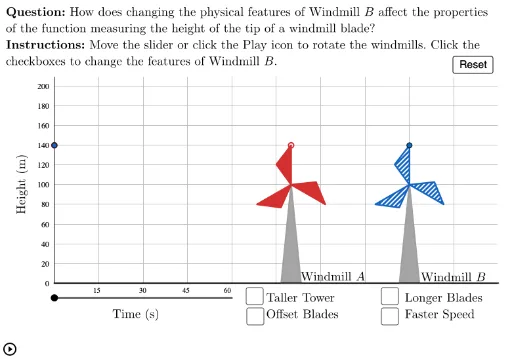
This example models the motion of a windmill blade. It involves concepts of trigonometric functions and periodic motion. Using GeoGebra commands such as If, Circle, Point, Segment, etc., a dynamic model of the windmill blade is constructed. Suitable for high school mathematics education, particularly in trigonometry and kinematics.
GeoGebra Commands & Parameters
If(OffsetBlades, 240, 0) → offsetCircle(A_1, radiusA) → dPoint(d) → A_2If(longPost, A_1 + v + (0, 30), A_1 + v) → B_1If(¬fastSpeed, speedA, speedA + 2) → speedBIf(longBlades, radiusA + 20, radiusA) → radiusBCircle(B_1, radiusB) → circle2Point(circle2) → B_2If(longPost, A_3 + v + (0, 30), A_3 + v) → B_3Segment((0, -15), (180, -15)) → mySliderPoint(mySlider) → sliderPtSequence("\hphantom{kkkkkk}", i, 1, 2) → spacersPolygon({(left, bottom), (left, top), (right, top), (right, bottom)}) → viewboxSegment((0, 0), (right, 0)) → groundLineVerticalText("\text{Height (m)}") → lblHeightSequence(Polygon[A_1, Rotate[A_3, ((-((i * 120))))° - angleA°, A_1], Rotate[A_2, ((-((i * 120))))° - angleA°, A_1]], i, 0, 2) → bladesSequence(Polygon[B_1, Rotate[B_2, ((-((i * 120))))° - angleB°, B_1], Rotate[B_3, ((-((i * 120))))° - angleB°, B_1]], i, 0, 2) → blades2Rotate(A_2, ((-angleA))°, A_1) → RotatePointARotate(B_2, ((-angleB))°, B_1) → RotatePointBTableText({{"\text{Taller Tower}", "\text{Offset Blades}"}, spacers, {"\text{Longer Blades}", "\text{Faster Speed}"}}, "vl") → changeOptions