
Measuring Volume 1: Understanding Volume by Stacking Cubes
Loading the math board and drawing, please wait…
In collections
Geo&Alg:Area Volume Pythagorean Th.
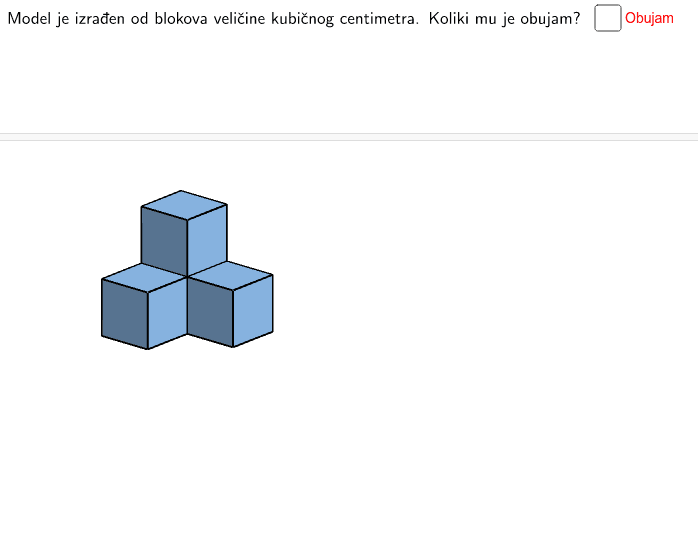
① This example demonstrates the concept of volume by stacking unit cubes to form a rectangular prism, making the abstract idea of three-dimensional space tangible. ② The core mathematical concept is volume, specifically the volume of a rectangular prism, and how it relates to counting unit cubes. ③ Construction details: The GeoGebra commands used include Point to define vertices, Cube to create individual cubes, and Translate with vectors s100, s010, and s001 to replicate cubes along three axes, forming a regular array. Objects include multiple points (A, B, C, etc.), faces (face7 to face12), and edges (edge13 to edge23), illustrating the step-by-step construction of a 3D solid. ④ Suitable for upper elementary or middle school students as an introduction to volume, and for teachers to demonstrate the derivation of the volume formula (length × width × height) by counting cubes.
GeoGebra Commands & Parameters
Point(Circle[B, Distance[A, B], Segment[A, B]]) → CPoint(Circle[J, Distance[I, J], Segment[I, J]]) → KPoint(Circle[R, Distance[Q, R], Segment[Q, R]]) → SPoint(Circle[H_1, Distance[G_1, H_1], Segment[G_1, H_1]]) → I_1Cube(G_1, H_1, I_1) → e_1, J_1, face11, face12, edge13, edge12, edge15, edge17, edge14, edge19, edge21, edge20, K_1, edge16, edge22, edge18, edge23, L_1, M_1, N_1, face7, face9, face8, face10Translate(Cube[(0, 0), (1, 0), Point[Circle[(1, 0), Distance[(0, 0), (1, 0)], Segment[(0, 0), (1, 0)]]]], Vector[(0, 0), (2, 1)]) → fTranslate(Cube[(0, 0), (1, 0), Point[Circle[(1, 0), Distance[(0, 0), (1, 0)], Segment[(0, 0), (1, 0)]]]], Vector[(0, 0), (1, 0)]) → gTranslate(Cube[(0, 0), (1, 0), Point[Circle[(1, 0), Distance[(0, 0), (1, 0)], Segment[(0, 0), (1, 0)]]]], Vector[(0, 0), (1, 1, 1)]) → hTranslate(Cube[(0, 0), (1, 0), Point[Circle[(1, 0), Distance[(0, 0), (1, 0)], Segment[(0, 0), (1, 0)]]]], Vector[(0, 0), (2, 1)]) → f'Translate(Cube[(0, 0), (1, 0), Point[Circle[(1, 0), Distance[(0, 0), (1, 0)], Segment[(0, 0), (1, 0)]]]], Vector[(0, 0), (1, 0)]) → g'Translate(Cube[(0, 0), (1, 0), Point[Circle[(1, 0), Distance[(0, 0), (1, 0)], Segment[(0, 0), (1, 0)]]]], Vector[(0, 0), (1, 1, 1)]) → h'Translate(Cube[(0, 0), (1, 0), Point[Circle[(1, 0), Distance[(0, 0), (1, 0)], Segment[(0, 0), (1, 0)]]]], Vector[(0, 0), (1, 1)]) → eTranslate(Cube[(0, 0), (1, 0), Point[Circle[(1, 0), Distance[(0, 0), (1, 0)], Segment[(0, 0), (1, 0)]]]], Vector[(0, 0), (1, 1)]) → e'Translate(Cube[(0, 0), (1, 0), Point[Circle[(1, 0), Distance[(0, 0), (1, 0)], Segment[(0, 0), (1, 0)]]]], Vector[(0, 0), (-4, 0)]) → aTranslate(Cube[(0, 0), (1, 0), Point[Circle[(1, 0), Distance[(0, 0), (1, 0)], Segment[(0, 0), (1, 0)]]]], Vector[(0, 0), (-4, 1)]) → bTranslate(Cube[(0, 0), (1, 0), Point[Circle[(1, 0), Distance[(0, 0), (1, 0)], Segment[(0, 0), (1, 0)]]]], Vector[(0, 0), (-3, 1)]) → cTranslate(Cube[(0, 0), (1, 0), Point[Circle[(1, 0), Distance[(0, 0), (1, 0)], Segment[(0, 0), (1, 0)]]]], Vector[(0, 0), (-4, 1, 1)]) → dTranslate(Cube[(0, 0), (1, 0), Point[Circle[(1, 0), Distance[(0, 0), (1, 0)], Segment[(0, 0), (1, 0)]]]], Vector[(0, 0), (-4, 0)]) → a'Translate(Cube[(0, 0), (1, 0), Point[Circle[(1, 0), Distance[(0, 0), (1, 0)], Segment[(0, 0), (1, 0)]]]], Vector[(0, 0), (-4, 1)]) → b'Translate(Cube[(0, 0), (1, 0), Point[Circle[(1, 0), Distance[(0, 0), (1, 0)], Segment[(0, 0), (1, 0)]]]], Vector[(0, 0), (-3, 1)]) → c'Translate(Cube[(0, 0), (1, 0), Point[Circle[(1, 0), Distance[(0, 0), (1, 0)], Segment[(0, 0), (1, 0)]]]], Vector[(0, 0), (-4, 1, 1)]) → d'
AI Drawing Prompt Reference
Create a 3D rectangular prism made of stacked unit cubes to illustrate volume. Start with a single unit cube, then duplicate and translate it along three axes (length, width, height) to form a regular array. The final shape is a two-layer block with cubes arranged in a grid, showing that volume equals the count of cubes. Ensure cubes are adjacent without gaps, and use perspective to show depth.
The prompt above was compiled from the original drawing commands and is for reference only.