
Measuring Equiangular Spirals in Nature
Loading the math board and drawing, please wait…
In collections
Logarithmic Spiral and Fibonacci Numbers
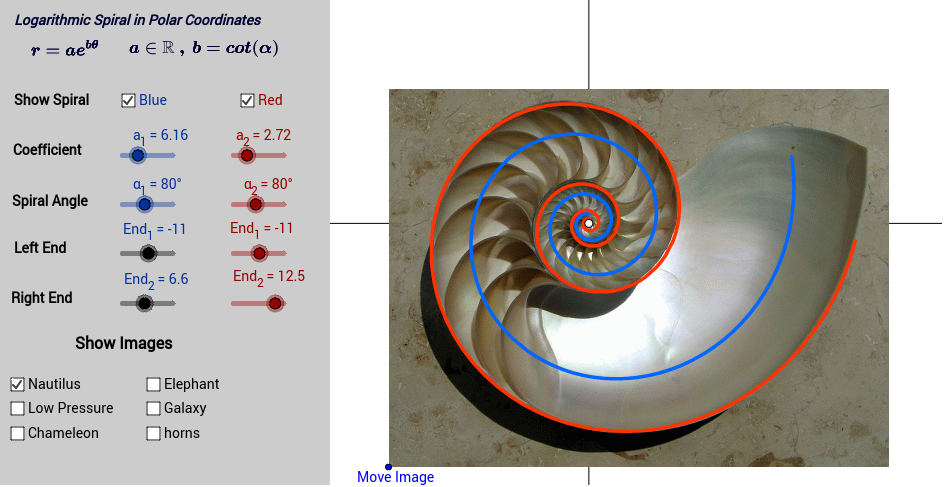
This GeoGebra applet demonstrates naturally occurring equiangular (logarithmic) spirals in the world. It involves the concept of parametric curves in coordinate geometry. Using commands like Corner, CurveCartesian, and Polygon, dynamic measurements of the spiral's properties can be made. Suitable for high school mathematics education and research.
GeoGebra Commands & Parameters
Corner(1) → AACorner(2) → BBCurveCartesian(a_1 * exp(b * t) * cos(t + p), a_1 * exp(b * t) * sin(t + p), t, t_{0 left}, t_{0 right}) → cCurveCartesian(a_2 * exp(b_1 * t) * cos(t + q), a_2 * exp(b_1 * t) * sin(t + q), t, t_{2 left}, t_{2 right}) → mPolygon(Corner[1], (x(Corner[1]) + 0.35 * Distance[Corner[1], Corner[2]], y(Corner[1])), (x(Corner[4]) + 0.35 * Distance[Corner[1], Corner[2]], y(Corner[4])), Corner[4]) → poly1, a, j, l, r
AI Drawing Prompt Reference
Draw an equiangular spiral using parametric curves, expanding outward from the center. First, draw two equiangular spirals, then create a quadrilateral between the starting points of the spirals, with each side 35% longer than the original.
The prompt above was compiled from the original drawing commands and is for reference only.