
Mean Value Theorem by Tatsuyoshi Hamada
Loading the math board and drawing, please wait…
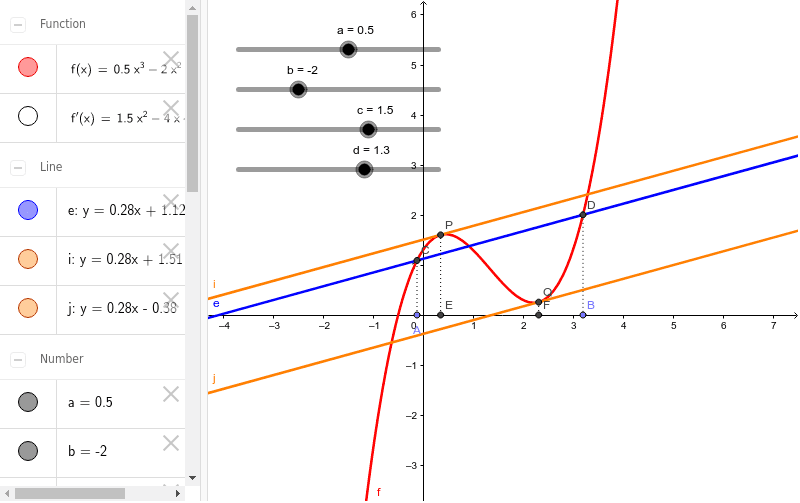
This example illustrates the Mean Value Theorem for cubic functions. The Mean Value Theorem is a fundamental concept in calculus, stating that for a continuous function on a closed interval, there exists at least one point where the derivative equals the average rate of change over the interval. Using the commands from the construction summary, one can observe how to draw function graphs, find roots, and plot tangents in GeoGebra. Suitable for high school mathematics education and learning.
GeoGebra Commands & Parameters
Point(xAxis) → APoint(xAxis) → BLine(C, D) → eSegment(A, C) → gSegment(D, B) → hRoot(f'(x) - Slope[e]) → E, FSegment(E, P) → kSegment(F, Q) → lIf((x(E) > x(A)) ∧ (x(E) < x(B)), Tangent[E, f]) → iIf((x(F) > x(A)) ∧ (x(F) < x(B)), Tangent[F, f]) → j