
Maximizing Trapezoid Area
Loading the math board and drawing, please wait…
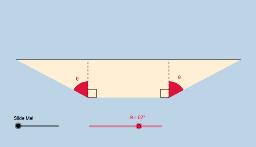
This example demonstrates how to maximize the area of an isosceles trapezoid by dynamically adjusting its parameters using calculus concepts like optimization and derivatives. Key GeoGebra commands used include Circle, Intersect, Rotate, Angle, Segment, Mirror, CircleSector, Vector, Polygon, Dilate, and Translate to construct the geometric figure and compute its area. Suitable for high school and above students learning optimization problems and geometric transformations in calculus.
GeoGebra Commands & Parameters
Circle(B, 1, xOyPlane) → cIntersect(h, c) → G, HRotate(G, (-θ), B, xOyPlane) → G'Angle(G', B, G, xOyPlane) → βSegment(B, G') → fSegment(B, G) → gMirror(G', l) → G''_1Segment(A, G''_1) → mSegment(A, B) → nSegment(G''_1, G') → iIntersect(h, i) → IMirror(I, l) → I'Circle(B, 1.5, xOyPlane) → dCircle(A, 1.5, xOyPlane) → eIntersect(p, e) → J, LIntersect(h, d) → M, NAngle(I', A, G''_1, xOyPlane) → γCircle(A, 0.2, xOyPlane) → kCircle(B, 0.2, xOyPlane) → qIntersect(f, q) → O,Intersect(h, q) → P, QIntersect(p, k) → R, SIntersect(m, k) → T,CircleSector(B, O, P, xOyPlane) → rCircleSector(A, R, T, xOyPlane) → sCircle(A, 1, xOyPlane) → tIntersect(p, t) → K, UMirror(K, l) → K'Vector(A, K) → uVector(B, K') → vAngle(K', B, A, xOyPlane) → δAngle(B, A, K, xOyPlane) → εSegment(A, I') → jSegment(B, I) → bPolygon(A, B, G', G''_1) → poly1, a_1, b_1, g', g''_1Dilate(G''_1, If[0 < o ≤ 1, 1 - o, 0], A) → DSegment(G''_1, D) → f_1Rotate(G''_1, If[1 < o ≤ 2, (-(π / 2 + θ)), (-(π / 2 + θ))], A) → FRotate(G''_1, If[1 < o ≤ 2, ((-((-o) - 1)) * (π / 2 + θ)), (-(π / 2 + θ))], A) → VRotate(D, If[1 < o ≤ 2, ((-((-o) - 1)) * (π / 2 + θ)), (-(π / 2 + θ))], A) → D'Angle(B, A, G''_1, xOyPlane) → αDilate(A, If[1 < o ≤ 2, 2 - o, 0], B) → A'Vector(A, A') → wTranslate(G''_1, w) → WTranslate(D, w) → D'_1Translate(G''_1, w) → ZRotate(G''_1, If[1 < o ≤ 2, ((-(o - 1)) * (π / 2 + θ)), (-(π / 2 + θ))], A) → A_1Rotate(D, If[1 < o ≤ 2, ((-(o - 1)) * (π / 2 + θ)), (-(π / 2 + θ))], A) → D'_2Segment(A_1, D'_2) → h_1Rotate(A_1, If[2 < o ≤ 3, ((-(o - 2)) * (π / 2 + θ)), (-(π / 2 + θ))], B) → B_1Rotate(D'_2, If[2 < o ≤ 3, ((-(o - 2)) * (π / 2 + θ)), (-(π / 2 + θ))], B) → C_1Segment(B_1, C_1) → g_1Area(poly1) → c_1