
Math and Art Combined
Loading the math board and drawing, please wait…
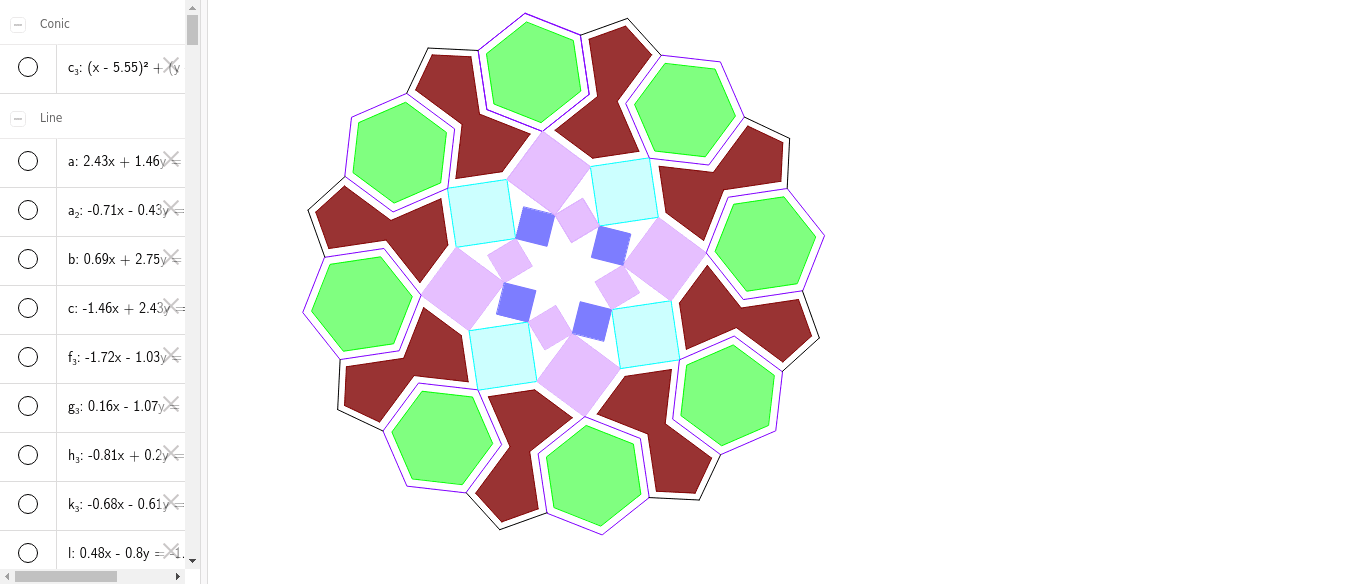
This example demonstrates the perfect combination of mathematics and art. It uses geometric shapes and transformations to illustrate concepts in geometry. Commands such as Line, Point, Polygon, Intersect, LineBisector, Mirror, Rotate, Circle, Segment, Dilate, and Midpoint are used in GeoGebra. Suitable for high school students and math enthusiasts to explore geometric transformations and construction.
GeoGebra Commands & Parameters
Line(A, B) → lPoint(l) → GPolygon(A, G, 8) → poly1, f, D, E, F, H, I, g, h, i, j, k, m, n, CLine(A, E) → pLine(D, I) → qLine(G, F) → rIntersect(p, q) → JLine(C, H) → sLineBisector(A, I) → tLineBisector(A, G) → aLineBisector(G, C) → bLineBisector(C, D) → cPolygon(I, G, 4) → poly2, d, e, f_1, g_1, K, LPolygon(A, C, 4) → poly3, h_1, i_1, j_1, k_1, M, NIntersect(t, d) → OPolygon(I, O, 4) → poly4, l_1, m_1, n_1, p_1, P, QIntersect(a, d) → RPolygon(R, G, 4) → poly5, q_1, r_1, s_1, t_1, S, TIntersect(t, f_1) → UPolygon(D, U, 4) → poly6, a_1, b_1, c_1, d_1, V, WIntersect(a, f_1) → ZPolygon(Z, F, 4) → poly7, e_1, f_2, g_2, h_2, A_1, B_1Intersect(p, d) → C_1Mirror(C_1, A) → D_1Rotate(D_1, 60°, A) → E_1Mirror(E_1, p) → F_1Polygon(D_1, E_1, 6) → poly8, i_2, J_1, j_2, k_2, l_2, m_2, n_2, G_1, H_1, I_1LineBisector(T, R) → p_2Intersect(p, p_2) → K_1Intersect(a, p_2) → L_1Polygon(C_1, L_1, 4) → poly9, q_2, r_2, s_2, t_2, M_1, N_1Mirror(poly9, a) → poly9'Mirror(poly9', b) → poly9''Mirror(poly9'', c) → poly9'''Mirror(poly9''', t) → poly10Mirror(poly10, a) → poly10'Mirror(poly10', b) → poly10''Mirror(poly10'', c) → poly10'''Mirror(poly8, a) → poly8'Mirror(poly8', b) → poly8''Mirror(poly8'', c) → poly8'''Mirror(poly8''', t) → poly11Mirror(poly11, a) → poly11'Mirror(poly11', b) → poly11''Mirror(poly11'', c) → poly11'''Mirror(M_1, t) → O_1Mirror(O_1, c) → P_1Mirror(P_1, b) → Q_1Mirror(Q_1, a) → R_1Mirror(R_1, t) → S_1Mirror(S_1, c) → T_1Mirror(T_1, b) → U_1Mirror(U_1, a) → V_1Line(P_1, O_1) → a_2Intersect(t, a_2) → W_1Polygon(W_1, M_1, 4) → poly12, b_2, c_2, d_2, e_2, Z_1, A_2Mirror(poly12, a) → poly12'Mirror(poly12', r) → poly12''Mirror(poly12', s) → poly12''_1Mirror(poly12''_1, q) → poly13Mirror(poly13, p) → poly13'Mirror(poly13', r) → poly13''Mirror(poly13'', s) → poly13'''Circle(J, D_1) → c_3Line(J, L_1) → f_3Mirror(B, f_3) → B'LineBisector(G_1, E_1) → g_3Intersect(f_3, g_3) → B_2Mirror(G_1, f_3) → C_2Mirror(E_1, f_3) → D_2Line(N_1, O) → h_3Intersect(c_3, h_3, 2) → E_2Segment(F_1, E_2) → i_3Mirror(F_1, h_3) → F_2Mirror(E_2, h_3) → G_2Segment(F_2, G_2) → j_3Mirror(I_1, h_3) → H_2Point(g_3) → I_2Line(I_2, j_3) → k_3Intersect(h_3, k_3) → J_2Mirror(I_2, h_3) → K_2Line(K_2, m_2) → l_3Line(I_1, H_2) → m_3Intersect(l_3, m_3) → L_2Line(L_2, l_2) → n_3Point(n_3) → M_2Line(M_2, t_2) → p_3Intersect(p_3, h_3) → N_2Mirror(C_1, h_3) → O_2Line(N_1, O_2) → q_3Mirror(p_3, h_3) → r_3Mirror(n_3, h_3) → s_3Intersect(m_3, s_3) → P_2Line(N_1, J_2) → t_3Mirror(M_2, t_3) → Q_2Polygon(M_2, N_2, Q_2, P_2, I_2, J_2, K_2, L_2) → poly14, m_4, n_4, q_4, p_4, i_4, j_4, k_4, l_4Mirror(M_2, p) → R_2Mirror(N_2, p) → S_2Mirror(Q_2, p) → T_2Mirror(P_2, p) → U_2Mirror(I_2, p) → V_2Mirror(J_2, p) → W_2Mirror(K_2, p) → Z_2Mirror(L_2, p) → A_3Polygon(R_2, S_2, T_2, U_2, V_2, W_2, Z_2, A_3) → poly14', r_4, s_4, t_4, u_2, v_2, w_2, z_2, a_3Mirror(R_2, r) → B_3Mirror(S_2, r) → C_3Mirror(T_2, r) → D_3Mirror(U_2, r) → E_3Mirror(V_2, r) → F_3Mirror(W_2, r) → G_3Mirror(Z_2, r) → H_3Mirror(A_3, r) → I_3Polygon(B_3, C_3, D_3, E_3, F_3, G_3, H_3, I_3) → poly14'', b_3, c_4, d_3, e_3, f_4, g_4, h_4, i_5Mirror(B_3, s) → J_3Mirror(C_3, s) → K_3Mirror(D_3, s) → L_3Mirror(E_3, s) → M_3Mirror(F_3, s) → N_3Mirror(G_3, s) → O_3Mirror(H_3, s) → P_3Mirror(I_3, s) → Q_3Polygon(J_3, K_3, L_3, M_3, N_3, O_3, P_3, Q_3) → poly14''', j_5, k_5, l_5, m_5, n_5, o_3, p_5, q_5Mirror(J_3, q) → R_3Mirror(K_3, q) → S_3Mirror(L_3, q) → T_3Mirror(M_3, q) → U_3Mirror(N_3, q) → V_3Mirror(O_3, q) → W_3Mirror(P_3, q) → Z_3Mirror(Q_3, q) → A_4Polygon(R_3, S_3, T_3, U_3, V_3, W_3, Z_3, A_4) → poly15, r_5, s_5, t_5, u_3, v_3, w_3, z_3, a_4Mirror(R_3, p) → B_4Mirror(S_3, p) → C_4Mirror(T_3, p) → D_4Mirror(U_3, p) → E_4Mirror(V_3, p) → F_4Mirror(W_3, p) → G_4Mirror(Z_3, p) → H_4Mirror(A_4, p) → I_4Polygon(B_4, C_4, D_4, E_4, F_4, G_4, H_4, I_4) → poly15', b_4, c_5, d_4, e_4, f_5, g_5, h_5, i_6Mirror(B_4, r) → J_4Mirror(C_4, r) → K_4Mirror(D_4, r) → L_4Mirror(E_4, r) → M_4Mirror(F_4, r) → N_4Mirror(G_4, r) → O_4Mirror(H_4, r) → P_4Mirror(I_4, r) → Q_4Polygon(J_4, K_4, L_4, M_4, N_4, O_4, P_4, Q_4) → poly15'', j_6, k_6, l_6, m_6, n_6, o_4, p_6, q_6Mirror(J_4, s) → R_4Mirror(K_4, s) → S_4Mirror(L_4, s) → T_4Mirror(M_4, s) → U_4Mirror(N_4, s) → V_4Mirror(O_4, s) → W_4Mirror(P_4, s) → Z_4Mirror(Q_4, s) → A_5Polygon(R_4, S_4, T_4, U_4, V_4, W_4, Z_4, A_5) → poly15''', r_6, s_6, t_6, u_4, v_4, w_4, z_4, a_5Mirror(F_2, q) → B_5Mirror(G_2, q) → C_5Segment(B_5, C_5) → b_5Mirror(B_5, c) → D_5Mirror(C_5, c) → E_5Segment(D_5, E_5) → d_5Mirror(Z_4, s) → F_5Mirror(D_5, s) → G_5Mirror(E_5, s) → H_5Segment(G_5, H_5) → e_5Mirror(G_5, b) → I_5Mirror(H_5, b) → J_5Segment(I_5, J_5) → f_6Mirror(I_5, r) → K_5Mirror(J_5, r) → L_5Segment(K_5, L_5) → g_6Mirror(K_5, f_3) → M_5Mirror(L_5, f_3) → N_5Segment(M_5, N_5) → h_6Mirror(M_5, p) → O_5Mirror(N_5, p) → P_5Segment(O_5, P_5) → a_6Mirror(O_5, t_3) → Q_5Mirror(P_5, t_3) → R_5Segment(Q_5, R_5) → b_6Mirror(Q_5, q) → S_5Mirror(R_5, q) → T_5Segment(S_5, T_5) → c_6Mirror(S_5, c) → U_5Mirror(T_5, c) → V_5Segment(U_5, V_5) → d_6Mirror(U_5, s) → W_5Mirror(V_5, s) → Z_5Segment(W_5, Z_5) → e_6Mirror(W_5, b) → A_6Mirror(Z_5, b) → B_6Segment(A_6, B_6) → f_7Mirror(A_6, r) → C_6Mirror(B_6, r) → D_6Segment(C_6, D_6) → g_7Mirror(C_6, f_3) → E_6Mirror(D_6, f_3) → F_6Segment(E_6, F_6) → h_7Dilate(poly11''', 0.85, I) → poly16Dilate(poly11'', 0.85, H) → poly11'''_1Dilate(poly11', 0.85, F) → poly11''_1Dilate(poly11, 0.85, E) → poly11'_1Dilate(poly8''', 0.85, D) → poly17Dilate(poly8'', 0.85, C) → poly8'''_1Midpoint(U_1, Q_1) → G_6Mirror(poly11''_1, G_6) → poly18Mirror(poly11'_1, G_6) → poly19
AI Drawing Prompt Reference
Start with a line segment and a point on it, construct an octagon, then draw diagonals to create auxiliary lines. Use their intersections to build several squares and a hexagon, guided by angle bisectors and perpendicular bisectors. Mirror and rotate these polygons across the symmetry axes to produce a symmetric geometric artwork that blends mathematics with visual art.
The prompt above was compiled from the original drawing commands and is for reference only.