
LR7-03-XT3 (Diagonals of a Kite)
Loading the math board and drawing, please wait…
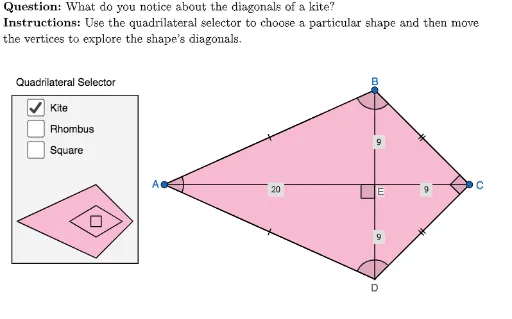
①This GeoGebra example dynamically demonstrates the properties of the diagonals of a kite, including that the diagonals are perpendicular and one diagonal bisects the other. ②Core mathematical concepts include quadrilateral classification, kite definition, diagonal properties, symmetry, and geometric constructions involving intersections, midpoints, and perpendicularity. ③Construction highlights: from the summary, commands such as Polygon, PointIn, Mirror, Circle, Point, Intersect, If, Segment, LaTeX, Midpoint, Angle, Line, and AreParallel are used to build the kite, auxiliary circles, rhombi, squares, and selectors to switch between different quadrilateral shapes, allowing dynamic exploration of diagonal relationships. ④Suitable for middle school geometry, particularly for grades 8-9 when learning quadrilateral properties, geometric proofs, and dynamic exploration; also useful for teacher demonstrations or student self-study.
GeoGebra Commands & Parameters
Polygon({(-6, 19), (26, 19), (26, 0), (-6, 0)}) → viewBoxPointIn(viewBox) → sqAPointIn(viewBox) → sqBMirror(sqA, AngularBisector[Line[sqA, sqB], OrthogonalLine[sqB, Line[sqA, sqB]]]) → sqCPointIn(viewBox) → kiteAPointIn(viewBox) → kiteCPointIn(viewBox) → rhomBPointIn(viewBox) → rhomACircle(rhomB, rhomA) → circle1forRhombusPoint(circle1forRhombus) → rhomCMirror(rhomB, Line[rhomA, rhomC]) → rhomDIntersect(Line[sqA, Line[sqB, sqC]], Line[sqC, Line[sqA, sqB]]) → sqDIf(showKite, kiteC, If[showRhombus, rhomC, sqC]) → CIf(showKite, kiteA, If[showRhombus, rhomA, sqA]) → ASegment(A, C) → ACCircle(Midpoint[AC], kiteA) → circle1forKitePointIn(circle1forKite) → kiteBPolygon({(-11.5, 9), (-9, 7.5), (-11.5, 6), (-14, 7.5)}) → selectorShapeRhombusMirror(kiteB, Line[kiteA, kiteC]) → kiteDLaTeX((((("\text{" * QUESTION) * "\\") * INSTRUCTIONS) * "}")) → TEXTPolygon({(-8, 7.5), (-11.5, 11), (-19, 7.5), (-11.5, 4)}) → selectorShapeKitePolygon({(-19.5, 19.5), (-7.5, 19.5), (-7.5, 3.5), (-19.5, 3.5)}) → selectorBoxQuadrilateralPolygon({(-12, 8), (-12, 7), (-11, 7), (-11, 8)}) → selectorShapeSquarePolygon({Vertex[selectorShapeRhombus]}) → selectorBorderRhombusPolygon({Vertex[selectorShapeKite]}) → selectorBorderKitePolygon({Vertex[selectorShapeSquare]}) → selectorBorderSquareIf(showKite, kiteD, If[showRhombus, rhomD, sqD]) → DIf(showKite, kiteB, If[showRhombus, rhomB, sqB]) → BSegment(A, B) → ABSegment(A, D) → ADSegment(B, C) → BCSegment(D, B) → DBSegment(D, C) → DCMidpoint(AB) → midABMidpoint(AD) → midADMidpoint(BC) → midBCMidpoint(D, C) → midDCSegment(A, Midpoint[Segment[midAB, B]]) → AB_1Segment(Midpoint[Segment[midAB, A]], B) → AB_2Segment(Midpoint[Segment[midAD, D]], A) → AD_1Segment(Midpoint[Segment[midAD, A]], D) → AD_2Segment(Midpoint[Segment[midBC, C]], B) → BC_1Segment(Midpoint[Segment[midBC, B]], C) → BC_2Segment(D, Midpoint[Segment[midDC, C]]) → DC_1Segment(Midpoint[Segment[midDC, D]], C) → DC_2Polygon({A, B, C, D}) → quadrilateralIntersect(AC, DB) → EAngle(A, B, C) → ABCAngle(B, C, D) → BCDAngle(C, D, A) → CDAAngle(D, A, B) → DABLine(A, B) → lineTopLine(A, D) → lineLeftLine(D, C) → lineBottomLine(B, C) → lineRightAreParallel(lineLeft, lineRight) → parallelLeftRightAreParallel(lineTop, lineBottom) → parallelTopBottomLaTeX(UnicodeToLetter[10003]) → cmarkLaTeX(UnicodeToLetter[10007]) → xmarkLaTeX(Distance[A, E]) → labelAELaTeX(Distance[B, E]) → labelBELaTeX(Distance[C, E]) → labelCELaTeX(Distance[D, E]) → labelDEAngle(A, E, D) → AED