
Loop of Coins: Tangent Circles in a Closed Geometric Chain
Loading the math board and drawing, please wait…
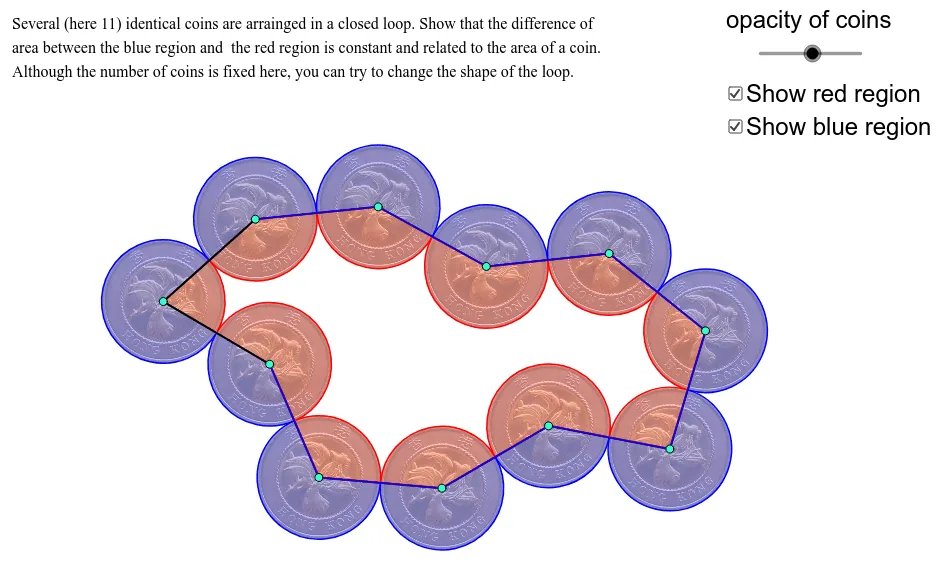
This GeoGebra example demonstrates a closed loop of congruent circles (coins) arranged so that adjacent circles are tangent, forming a ring-like geometric chain. It highlights core concepts including circle tangency, equilateral triangles formed by connecting circle centers, circle sectors, rotational symmetry, and polygonal construction. The construction relies on GeoGebra commands such as Circle, Point, Intersect, PolyLine, Segment, Midpoint, and CircleSector, with objects A through H representing centers and intersection points, c through h representing circle objects, and auxiliary text and image elements (text1, pic1–pic7) for annotation. Suitable for high school geometry courses, it serves as a dynamic demonstration for lessons on circles, tangents, triangle area, geometric construction, and transformation, supporting both teacher-led instruction and student inquiry.
GeoGebra Commands & Parameters
Circle(A, 2) → cPoint(c) → BCircle(B, 2) → dPoint(d) → CCircle(C, 2) → ePoint(e) → DCircle(D, 2) → fPoint(f) → ECircle(E, 2) → gPoint(g) → FCircle(F, 2) → hPoint(h) → GCircle(G, 2) → kPoint(k) → HCircle(H, 2) → pPoint(p) → ICircle(I, 2) → qPoint(q) → JCircle(J, 2) → rCircle(A, 1) → s_1Circle(B, 1) → t_1Circle(C, 1) → c_1Circle(D, 1) → d_1Circle(E, 1) → e_1Circle(F, 1) → f_1Circle(G, 1) → g_1Circle(H, 1) → h_1Circle(I, 1) → k_1Circle(J, 1) → p_1Intersect(c, r, 2) → KCircle(K, 1) → q_1PolyLine(A, B, C, D, E, F, G, H, I, J) → linePolySegment(K, A) → line2Segment(K, J) → line3Midpoint(A, B) → LMidpoint(B, C) → MMidpoint(C, D) → NMidpoint(D, E) → OMidpoint(E, F) → PMidpoint(F, G) → QMidpoint(G, H) → RMidpoint(H, I) → SMidpoint(I, J) → TMidpoint(J, K) → UMidpoint(K, A) → VCircleSector(A, V, L) → s_2CircleSector(B, L, M) → t_2CircleSector(C, M, N) → r_2CircleSector(D, N, O) → c_2CircleSector(E, O, P) → d_2CircleSector(F, P, Q) → e_2CircleSector(G, Q, R) → f_2CircleSector(H, R, S) → g_2CircleSector(I, S, T) → h_2CircleSector(J, T, U) → k_2CircleSector(K, U, V) → p_2CircleSector(A, L, V) → q_3CircleSector(B, M, L) → r_3CircleSector(C, N, M) → s_3CircleSector(D, O, N) → t_3CircleSector(E, P, O) → c_3CircleSector(F, Q, P) → d_3CircleSector(G, R, Q) → e_3CircleSector(H, S, R) → f_3CircleSector(I, T, S) → g_3CircleSector(J, U, T) → h_3CircleSector(K, V, U) → k_3Defined(K) → loop
AI Drawing Prompt Reference
Draw a closed loop of 10 congruent circles with a radius of 2, where each circle is tangent to its neighbors. Start by drawing the first circle, then sequentially draw the remaining circles with their centers on the circumference of the previous circle. Next, draw smaller circles with a radius of 1, ensuring their centers are on the circumference of the larger circles. Finally, connect the centers of the circles to form a polygon, and draw line segments connecting the centers to the points of tangency, as well as some circular sectors.
The prompt above was compiled from the original drawing commands and is for reference only.