
Logarithmic Parent Function Transformations: f(x)=log x to g(x)=1+2log(3x+4)
Loading the math board and drawing, please wait…
In collections
CCGPS AA Unit 6 Lesson 4
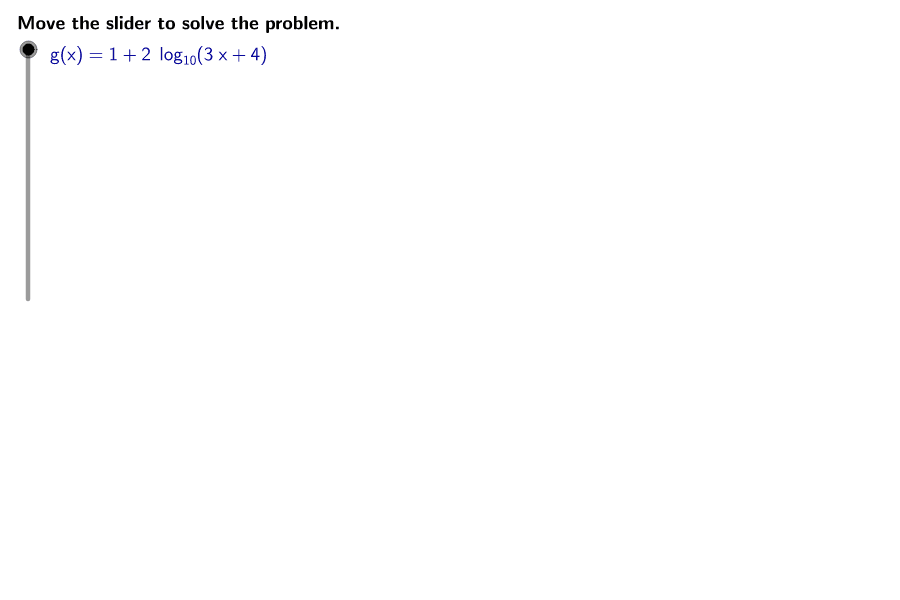
This GeoGebra example demonstrates the transformation of the parent logarithmic function f(x) = log x into g(x) = 1 + 2·log(3x + 4), illustrating horizontal compression, horizontal shift, vertical stretch, and vertical shift in a single dynamic construction. Core mathematical concepts include logarithmic functions, function transformations, composite functions, domain and range, and graphical feature identification. The construction leverages GeoGebra commands such as LaTeX for mathematical typesetting, Corner for on-screen positioning, FractionText for fractional text rendering, and If for conditional logic. Key objects include stepMax, stepper, steps, and counter for step-by-step interactivity; RandomizationText and button1 for randomized problem generation; parameters a, b, c, d to control transformation coefficients; functions f, g, h, p to represent the parent and transformed curves; xmin, xmax, ymin, ymax for dynamic viewport control; and intercept, relation, domain for annotating key graphical features. It is designed for high school Algebra II or precalculus students, function transformation units, classroom demonstrations, and self-paced exploratory learning.
GeoGebra Commands & Parameters
LaTeX(steps) → counterLaTeX("\text{Use the buttons below to return to the original problem or}\cr\text{randomly generate a similar practice problem.}") → RandomizationTextCorner(1) → ACorner(3) → BLaTeX((("\textcolor{#000099}{g(x)=" * g) * "}")) → ProblemLaTeX("\text{Identify the transformation(s) of the parent function.}") → text1LaTeX("\text{Compare the domain and range of the parent function to those of the transformed}\cr\text{function }\textcolor{#000099}{g(x)}.") → text8LaTeX("\text{The domain of the parent function is }\textcolor{#006633}{(0, \infty)}.") → text9FractionText(((-d)) / c) → LLLaTeX("\text{The transformations of }\textcolor{#006633}{f(x)}\text{ that result in }\textcolor{#000099}{g(x)}\text{ alter the rate at which the function}\cr\text{values change, but not their upper and lower bounds.}") → text12LaTeX("\text{Calculate the y-intercept of }\textcolor{#000099}{g(x)}.") → text13If(Defined[g(0)], LaTeX[("\approx " * g(0))], LaTeX["\text{ is undefined.}"]) → interceptIf(c < 0, "<", ">") → relationIf(c < 0, LaTeX[(("\left(-\infty," * LL) * "\right)")], LaTeX[(("\left(" * LL) * ",\infty\right)")]) → domainLaTeX((((((((((("\text{Since }\textcolor{#000099}{g(x)}\text{ is a logarithmic function, the domain of }\textcolor{#000099}{g(x)}\text{ is defined by the argument}\cr\text{of the logarithmic term, }\textcolor{#000099}{" * h) * "}\text{. The condition }\textcolor{#000099}{") * h) * " > 0}\text{ or }\textcolor{#000099}{x ") * relation) * " ") * LL) * "}\text{ exists}\cr\text{on the argument. Therefore, the domain is }\textcolor{#000099}{") * domain) * "}.")) → text10If(Defined[g(0)], LaTeX[(((((("\text{The y-intercept of }\textcolor{#000099}{g(x)=" * g) * "}\text{ is approximately }\textcolor{#000099}{") * g(0)) * "}\text{, or }\cr\textcolor{#000099}{(0, ") * g(0)) * ")}.")], LaTeX[(("\text{The y-intercept of }\textcolor{#000099}{g(x)=" * g) * "}\text{ is undefined.}")]) → text16LaTeX((("\text{To determine how the parent function }\textcolor{#006633}{f(x) = log(x)}\text{ was transformed, compare it to }\cr\textcolor{#000099}{g(x)=" * g) * "}.")) → text2LaTeX("\text{The range of both functions is }\textcolor{#000099}{(−\infty,\infty)}.") → text11LaTeX("\text{Move the slider to solve the problem.}") → text0LaTeX((((("\bullet \text{ The coefficient }\textcolor{#000099}{" * c) * "}\text{ is in the argument of the logarithm, }\textcolor{#000099}{") * h) * "}\text{. Multiplying}\cr\text{ the independent variable by a constant is the transformation }\textcolor{#000099}{g(x) = }\textcolor{#006633}{f(}\textcolor{#000099}{k}\textcolor{#006633}{x)}.")) → text5LaTeX((((("\bullet \text{ Also notice that }\textcolor{#000099}{" * b) * "}\text{ is multiplied by }\textcolor{#000099}{") * p) * "}\text{. Multiplying the}\cr\text{ function value by a constant is the transformation }\textcolor{#000099}{g(x) = k }\textcolor{#000099}{ \cdot }\textcolor{#006633}{f(x)}.")) → text4LaTeX((((("\bullet \text{ Furthermore, note the addition of }\textcolor{#000099}{" * d) * "}\text{ in the argument of the logarithm, }\textcolor{#000099}{") * h) * "}\text{.}\cr\text{ Adding a constant to the independent variable in the argument of the}\cr\text{ logarithm is the transformation }\textcolor{#000099}{g(x)=}\textcolor{#006633}{f(x}\textcolor{#000099}{+k}\textcolor{#006633}{)}.")) → text6LaTeX((((("\bullet \text{ First, note that in }\textcolor{#000099}{g(x)}\text{, the constant }\textcolor{#000099}{" * a) * "}\text{ is added to }\textcolor{#000099}{") * f) * "}.\cr\text{ Adding a constant to the function value is the transformation }\textcolor{#000099}{g(x)=}\textcolor{#006633}{f(x)}\textcolor{#000099}{+k}.")) → text3LaTeX("\text{Therefore, four transformations—}\textcolor{#000099}{g(x) = f(x) + k}\text{, }\textcolor{#000099}{g(x) = k \cdot f(x)}\text{, }\textcolor{#000099}{g(x) = f(kx)},\cr\text{ and }\textcolor{#000099}{g(x) = f(x + k)}\text{—have been performed on the parent function }\textcolor{#006633}{f(x) = log(x)}.") → text7LaTeX("\text{The y-intercept of }\textcolor{#000099}{g(x)}\text{ is defined by the function value }\textcolor{#000099}{g(0)}\text{. Substitute }\textcolor{#000099}{0}\text{ for }\textcolor{#000099}{x}\cr\text{ and solve for }\textcolor{#000099}{g(0)}:") → text14LaTeX(((((((((((((((((((" \textcolor{#000099}{g(x)=" * g) * "}\cr \textcolor{#000099}{g(0)=") * a) * "+") * b) * "log\left[") * c) * "(0)+") * d) * "\right]}\cr \textcolor{#000099}{g(0)=") * a) * "+") * b) * "log") * h(0)) * "}\cr \textcolor{#000099}{g(0) ") * intercept) * "}\cr ")) → text15
AI Drawing Prompt Reference
Draw a teaching diagram for logarithmic function transformations. Show the parent function f(x)=log x as one curve)Skip, and the transformed function g(x)=1+2log(3x+4) as another curve. Label the domain of the parent as (0,∞) and its range as all real numbers. For the transformed function, indicate its domain is x>-4/3 (from 3x+4>0) and range is all real numbers. Mark the y-intercept of g(x) if it exists. Use different colors for the two curvescars. Add text annotations explaining the transformations: horizontal compression, horizontal shift, vertical stretch, and vertical shift. Include a slider or buttons to step through the transformation process and optionally generate random similar problems.
The prompt above was compiled from the original drawing commands and is for reference only.