
Logarithmic Action (2)! Reciprocal Property Dynamic Discovery
Loading the math board and drawing, please wait…
In collections
Exploring Exponential & Logarithmic Functions
Exploring Exponential & Logarithmic Functions
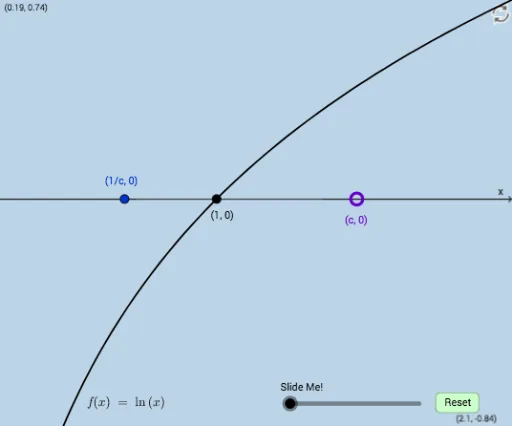
This interactive GeoGebra example dynamically demonstrates the reciprocal property of logarithms: log_a(b) and log_b(a) are reciprocals of each other. The core mathematical concept is the logarithmic function and its operational properties, especially the change-of-base formula visualized through geometric construction. The construction uses text fields and input boxes to allow users to modify the base and argument in real time. Key GeoGebra commands include Intersect, Dilate, Segment, Vector, Translate, Rotate, and Distance, along with objects like points, lines, and input boxes. This resource is suitable for high school and college students exploring logarithmic identities, and serves as an effective visual aid for teachers explaining the symmetry and reciprocal nature of logarithms in classroom settings.
GeoGebra Commands & Parameters
Textfield(a) → InputBox1Textfield(f_1) → InputBox2Textfield(f) → InputBox3Intersect(f, h, 1) → EDilate(F, If[0 < d ≤ 1, 1 - d, 0], A) → F'Dilate(A, If[1 < d ≤ 2, 2 - d, 0], B) → A'Segment(A, A') → jDilate(B, If[2 < d ≤ 3, 3 - d, 0], G) → B'Vector(B, B') → uTranslate(A, u) → A'_1Translate(A', u) → A''Segment(A'_1, A'') → j'Rotate(A'_1, If[3 < d ≤ 4, ((-(d - 3)) * π / 2), ((-π)) / 2], F) → HRotate(A'', If[3 < d ≤ 4, ((-(d - 3)) * π / 2), ((-π)) / 2], F) → A'''Segment(H, A''') → j''Rotate(A'_1, If[3 < d ≤ 4, ((d - 3) * π / 2), π / 2], F) → IRotate(A'', If[3 < d ≤ 4, ((d - 3) * π / 2), π / 2], F) → A'''_1Dilate(D, If[4 < d ≤ 5, 5 - d, 0], E) → D'Segment(D, D') → lDilate(A, If[1 < d ≤ 2, 2 - d, 0], C) → A'_2Segment(A, A'_2) → mDilate(A, If[2 < d ≤ 3, 3 - d, 0], R) → C'Vector(C, C') → vIntersect(f, p, 1) → NRotate(F, If[5 < d ≤ 6, ((d - 5) * π / 2), π / 2], F) → F'_1Rotate(F', If[5 < d ≤ 6, ((d - 5) * π / 2), π / 2], F) → F''Dilate(F, If[6 < d ≤ 7, 7 - d, 0], M) → F'_2Vector(F, F'_2) → wTranslate(F'_1, w) → PTranslate(F'', w) → F'''Distance(A, C) → distanceACVector(A, A'_2) → iVector(A, C') → b_1Translate(i, b_1) → i'Dilate(W, If[6 < d ≤ 7, 7 - d, 0], L) → W'Vector(W, W') → w_1Distance(W, L) → distanceWLDilate(T, If[2 < d ≤ 3, 3 - d, 0], U) → T'Vector(T, T') → eDistance(T, U) → distanceTURotate(C, If[3 < d ≤ 4, ((-(d - 3)) * π), (-π)], A) → C'_1Vector(A, C'_1) → qDilate(A, If[4 < d ≤ 5, 5 - d, 0], T) → A'_3Vector(A, A'_3) → u_1Translate(C'_1, u_1) → QVector(A'_3, Q) → v_1
AI Drawing Prompt Reference
Draw a dynamic geometric figure demonstrating the reciprocal property of logarithms. Include two logarithmic curves with different bases, intersecting at a point. Provide two input boxes to change the base and argument. Place points on the axes and use transformations like translation, rotation, and dilation to construct segments representing the two logarithm values, with their lengths displayed. Use a slider to animate the process, showing that when base and argument are swapped, the segment lengths are reciprocals. Add auxiliary points, vectors, and distance labels to clarify the geometric meaning of the change-of-base formula.
The prompt above was compiled from the original drawing commands and is for reference only.