
Locus Related to Descartes' Folium
Loading the math board and drawing, please wait…
In collections
History of Maths
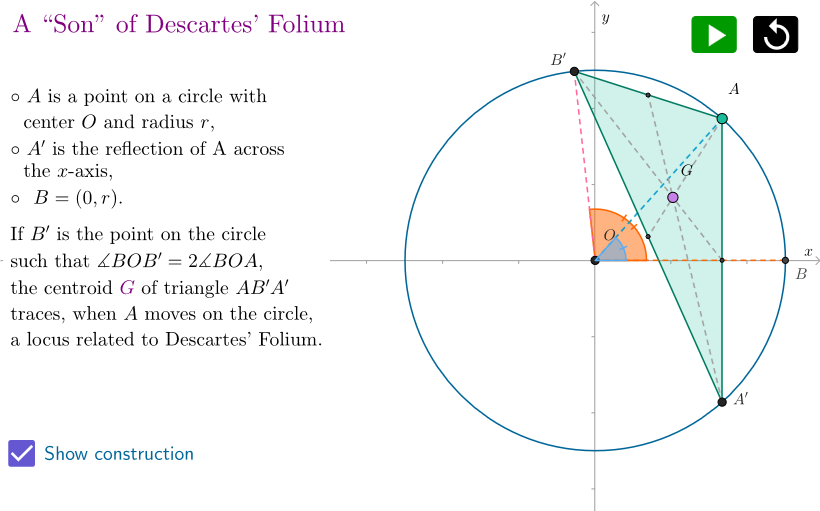
This example demonstrates the trajectory of the centroid of a special triangle as it varies. The trajectory is related to Descartes' Folium. Key mathematical concepts include centroid calculation, geometric construction, and parametric curves. Construction involves using GeoGebra commands such as Circle, Point, Midpoint, and Polygon. Suitable for high school students or math enthusiasts learning about geometric loci and parametric equations.
GeoGebra Commands & Parameters
Circle((0, 0), r) → cPoint(c) → AMirror(A, xAxis) → A'Segment(O, A) → gAngle(B, O, A) → angBOARotate(B, (2 * angBOA), O) → B'Segment(O, B') → segmOBPRPolygon(A, B', A') → poli1, a', a, b'Midpoint(A, B') → CMidpoint(B', A') → DMidpoint(A', A) → ESegment(A', C) → bSegment(E, B') → dSegment(A, D) → eIntersect(b, d) → GSegment(B, O) → segmBOAngle(B, O, B') → angBOBPR
AI Drawing Prompt Reference
Draw a circle centered at the origin. Place a point on the circle and reflect it across the horizontal axis. Connect the center to the point on the circle to form a radius. Construct an angle at the center, then rotate the radius by twice that angle to get another radius. Form a triangle using the original point, the rotated point, and the reflected point. Find the midpoints of the three sides of the triangle, then draw segments from each midpoint to the opposite vertex; these three medians intersect at the centroid. Finally, connect the center to the rotated point and mark the relevant angles.
The prompt above was compiled from the original drawing commands and is for reference only.