
Locus of a Hyperbola
Loading the math board and drawing, please wait…
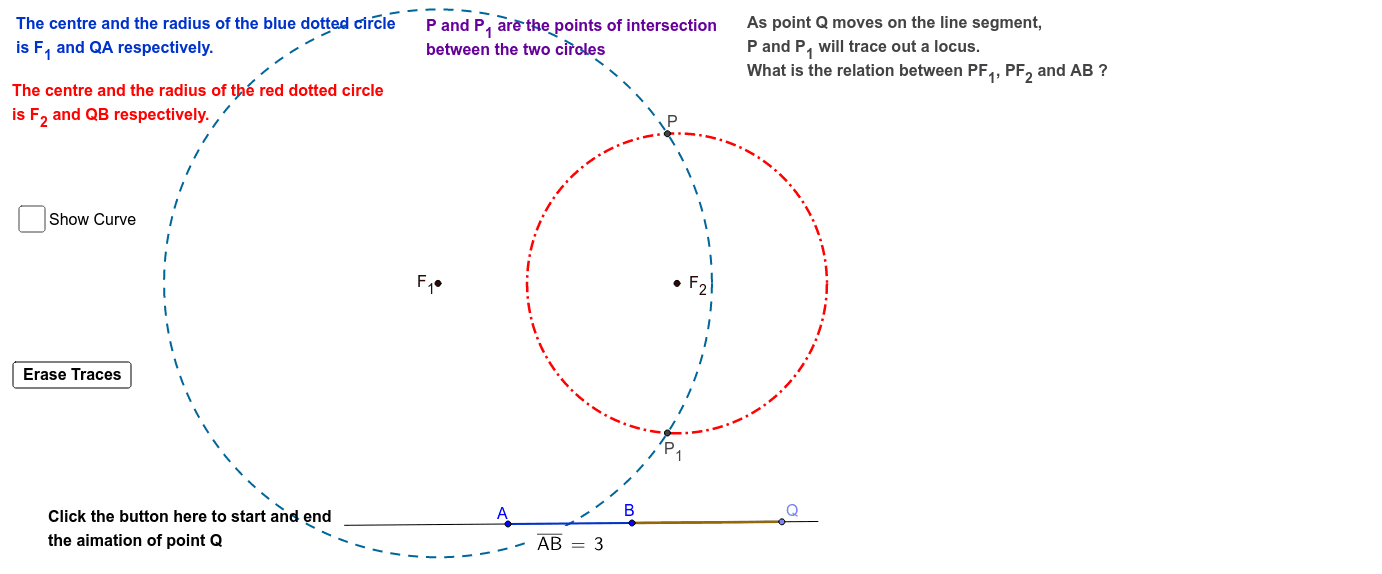
This example demonstrates the construction of a hyperbola's locus. Key math concepts include hyperbola definition, linear equations, tangent lines, and coordinate geometry. GeoGebra commands used are Segment, Line, Point, Circle, Intersect, Locus, Distance, and Midpoint, with objects like A, B, a, b, C, D, c, F_1, F_2, Q, AE, BE, d, e, P_1, P, loc1, loc2, AB, etc. Suitable for high school and above students to explore hyperbola geometry and locus equations.
GeoGebra Commands & Parameters
Segment(A, B) → aLine(A, B) → bPoint(b) → CPoint(b) → DSegment(C, D) → cPoint(xAxis) → F_1Point(xAxis) → F_2Point(c) → QSegment(A, Q) → AESegment(B, Q) → BECircle(F_1, AE) → dCircle(F_2, BE) → eIntersect(e, d) → P_1, P, ,Locus(P, Q) → loc1Locus(P_1, Q) → loc2Distance(A, B) → ABMidpoint(A, B) →
AI Drawing Prompt Reference
Draw the locus of a hyperbola to demonstrate its definition and geometric construction. Start by drawing a line segment and marking two points on it. Use these points as centers to draw circles with diameters equal to the segment. The intersection points of these circles form the locus. Draw the perpendicular bisector of the segment and mark a point on it. Connect this point to the circle intersections, and find the midpoint of these line segments. The locus of these midpoints is the hyperbola. Label the foci and the hyperbola, highlighting its geometric properties.
The prompt above was compiled from the original drawing commands and is for reference only.