
Liu Hui's Proof of Pyramid Volume: Prism Dissection and Volume Relationship
Loading the math board and drawing, please wait…
In collections
Volumes in Ancient Chinese Mathematics 中國古算中的體積
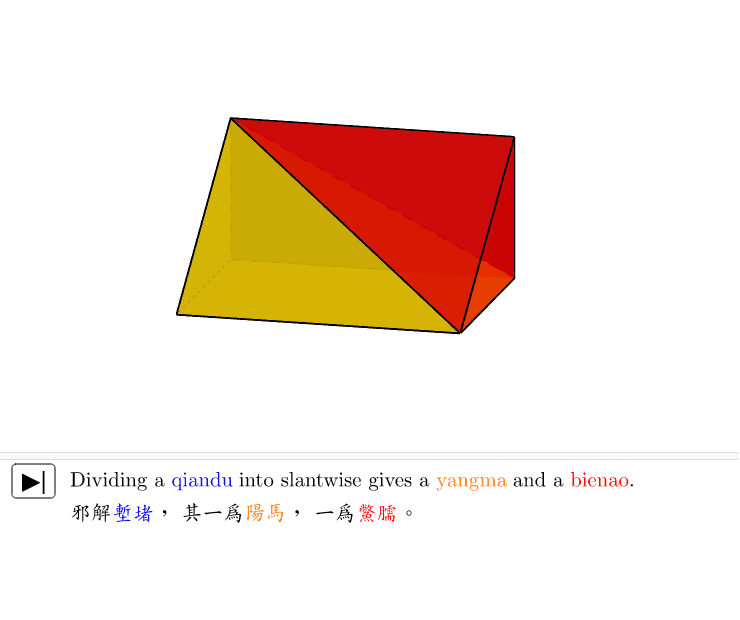
This GeoGebra example demonstrates Liu Hui's classical proof of the pyramid volume formula, visually showing how a prism can be dissected into three pyramids of equal volume to derive V = (1/3)Sh. Core mathematical concepts include solid geometry, the prism–pyramid volume relationship, the one-third volume principle, polyhedral face and edge topology, and rigid transformations such as vector translation and rotation. Construction highlights: the model employs GeoGebra commands Vector, Polygon, Prism, Translate, Midpoint, Rotate, and Sequence to generate points A through G, faces such as faceABFD and faceDEGF, and edges such as edgeAB and edgeDF, illustrating step-by-step decomposition and reassembly of three-dimensional solids. Suitable for high school solid geometry instruction, university history of mathematics courses, and classroom demonstrations of the geometric origin of pyramid volume.
GeoGebra Commands & Parameters
Vector((0, 0, 0), (3, 0, 3)) → vPolygon(A, D, E) → poly1, e, a, dPrism(poly1, B) → b, F_1, edgeBF, edgeFG, edgeBG, F, faceABFD, faceDEGF, faceABGE, faceBFG, edgeAB, edgeDF, edgeEGTranslate(B, Vector[(s * v)]) → B'Translate(C, Vector[(s * v)]) → C'Translate(F, Vector[(s * v)]) → F'Translate(E, Vector[(s * v)]) → E'Translate(Pyramid[Polygon[B, C, F], E], Vector[(s * v)]) → cTranslate(Pyramid[Polygon[A, B, C, D], E], Vector[(0 * v)]) → fMidpoint(A, E) → GMidpoint(D, E) → HMidpoint(B, F) → IMidpoint(C, F) → JMidpoint(A, B) → KMidpoint(D, C) → LMidpoint(E, F) → MMidpoint(B, C) → NMidpoint(A, D) → OMidpoint(M, L) → PMidpoint(M, K) → QRotate(Prism[Polygon[D, L, P, H], O], 0°, zAxis) → gRotate(Prism[Polygon[A, O, G], K], 0°, zAxis) → hMidpoint(K, L) → RRotate(Prism[Polygon[Q, R, N], P], 0°, zAxis) → iTranslate(M, Vector[(s * v)]) → M'Translate(P, Vector[(s * v)]) → P'Translate(Q, Vector[(s * v)]) → Q'Translate(I, Vector[(s * v)]) → I'Translate(J, Vector[(s * v)]) → J'Rotate(Prism[Polygon[I', J', F'], Q'], 0°, zAxis) → jTranslate(N, Vector[(s * v)]) → N'Rotate(Prism[Polygon[Q', N', I'], P'], 0°, zAxis) → kVector(B, Q) → uSequence(Translate[Dilate[list1, 0.5, B'], Vector[(t * u)]], t, 0, 1) → list1'Sequence(Translate[Dilate[list2, 0.5, B], Vector[(t * u)]], t, 0, 1) → list2'Sequence(Translate[Dilate[list1, 0.25, B'], Vector[(t * u / 2)]], t, 0, 3) → list1''Sequence(Translate[Dilate[list2, 0.25, B], Vector[(t * u / 2)]], t, 0, 3) → list2''Sequence(Translate[Dilate[list1, 0.125, B'], Vector[(t * u / 4)]], t, 0, 7) → list1'''Sequence(Translate[Dilate[list2, 0.125, B], Vector[(t * u / 4)]], t, 0, 7) → list2'''Sequence(Translate[Dilate[list1, 0.0625, B'], Vector[(t * u / 8)]], t, 0, 15) → list1''''Sequence(Translate[Dilate[list2, 0.0625, B], Vector[(t * u / 8)]], t, 0, 15) → list2''''Translate(Pyramid[Polygon[B, C, F], E], Vector[(s * v)]) → c'Translate(Pyramid[Polygon[A, B, C, D], E], Vector[(0 * v)]) → f'Rotate(Prism[Polygon[D, L, P, H], O], 0°, zAxis) → g'Rotate(Prism[Polygon[A, O, G], K], 0°, zAxis) → h'Rotate(Prism[Polygon[Q, R, N], P], 0°, zAxis) → i'Rotate(Prism[Polygon[I', J', F'], Q'], 0°, zAxis) → j'Rotate(Prism[Polygon[Q', N', I'], P'], 0°, zAxis) → k'
AI Drawing Prompt Reference
Draw a three-dimensional prism dissected into three equal-volume pyramids to illustrate Liu Hui's proof of the pyramid volume formula. Start with a triangular prism, marking all vertices and edges. Use translations and rotations to split the prism into smaller prisms and pyramids, showing how they reassemble. Add midpoints and connecting lines inside the prism to create finer subdivisions, and generate recursive patterns through scaling and translation to suggest an infinite approximation. The overall figure should clearly display the prism, pyramids, midpoints, translation vectors, and rotation axes, emphasizing the geometric intuition behind the volume relationship.
The prompt above was compiled from the original drawing commands and is for reference only.