
Lines of Symmetry - Rectangle
Loading the math board and drawing, please wait…
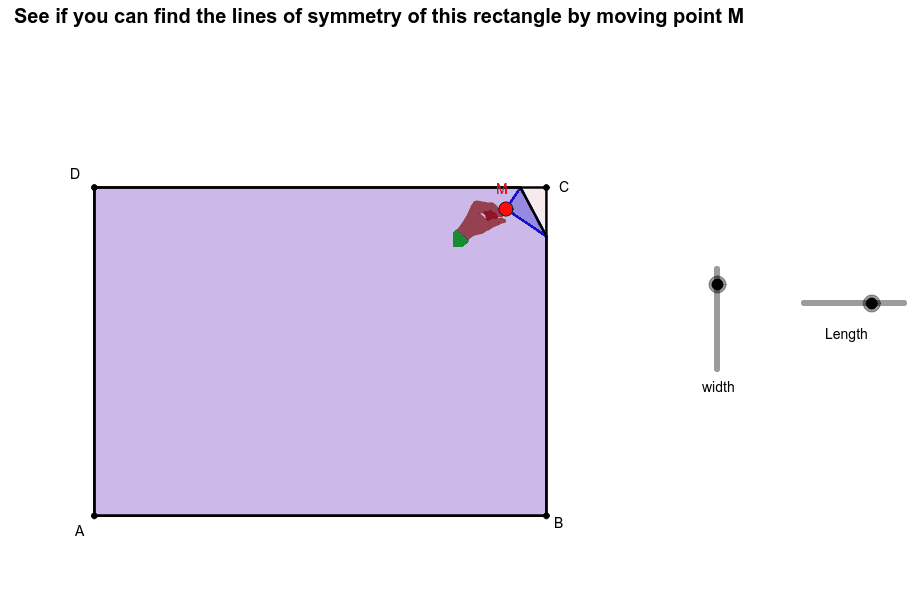
This example demonstrates the symmetry axes of a rectangle. It involves core mathematical concepts like symmetry, line segments, midpoints, and reflection transformations. The construction uses GeoGebra commands such as Polygon, Line, LineBisector, Intersect, Mirror, Midpoint, Segment, and If. Suitable for middle school students and above to learn geometric transformations and symmetry.
GeoGebra Commands & Parameters
Polygon(A, B, C, D) → poly1, a_1, b_1, d_1, c_1Line(C, B) → jLine(D, C) → kLine(A, B) → lLine(D, A) → mLineBisector(M, C) → cIntersect(c, k) → F_1Intersect(c, l) → GIntersect(c, m) → HIntersect(j, c) → IMirror(B, c) → B'Mirror(D, c) → D'Mirror(A, c) → A'Polygon(M, F_1, I) → poly2, i, e, fPolygon(F_1, D, A, B, I) → poly3, f_1, d, a_2, b_2, i_1Polygon(F_1, M, B', G) → poly4, f_2, e_1, b', gPolygon(F_1, D, A, G) → poly5, f_3, d_2, a_3, g_1Polygon(F_1, M, B', A', H) → poly6, f_4, e_2, b'_1, a', hPolygon(F_1, D, H) → poly7, h_1, f_5, d_3Polygon(H, D', M, I) → poly8, h_2, d', e_3, i_2Polygon(H, A, B, I) → poly9, h_3, a_4, b_3, i_3Polygon(H, D', M, B', G) → poly10, h_4, d'_1, e_4, b'_2, g_2Polygon(H, A, G) → poly11, g_3, h_5, a_5Polygon(G, B, I) → poly13, i_4, g_4, b_4Polygon(G, A', D', M, I) → poly12, n, p, q, r, sMidpoint(D, C) → EMidpoint(A, B) → FSegment(E, F) → tIf(Distance[M, D] ≤ 0.05, 1, 0) → okMidpoint(C, M) → JMidpoint(b_1) → KMidpoint(c_1) → LLine(L, K) → a1Line(E, F) → b1
AI Drawing Prompt Reference
Draw a rectangle and display its lines of symmetry. First, sketch the four sides of the rectangle. Then find the midpoints of each side and connect the midpoints of opposite sides to form two symmetry axes. Next, reflect each vertex of the rectangle across the symmetry axes to obtain new vertices. Finally, use these new vertices to draw additional polygons, highlighting the symmetry.
The prompt above was compiled from the original drawing commands and is for reference only.