
Area of a Rectangle by Joy
Loading the math board and drawing, please wait…
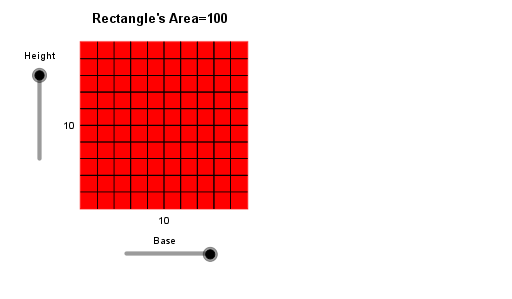
This example demonstrates how to calculate the area of a rectangle using geometric construction. Key mathematical concepts include the properties of rectangles and area calculation. It uses commands such as Point, Segment, Circle, OrthogonalLine, Intersect, and Polygon in GeoGebra. Suitable for middle school and above students learning geometric construction and area calculation.
GeoGebra Commands & Parameters
Point(Circle[A, Base]) → BSegment(A, B) → bPoint(Circle[A, Height]) → CSegment(A, C) → dCircle(A, C) → eOrthogonalLine(A, b) → fIntersect(e, f, 1) → DOrthogonalLine(B, b) → gOrthogonalLine(D, f) → hIntersect(g, h) → EPolygon(A, D, E, B) → P, a_1, d_1, e_1, b_1Midpoint(A, D) → FMidpoint(A, B) → GPoint(Circle[A, 1]) → HSegment(A, H) → iPoint(Circle[A, 2]) → ISegment(A, I) → jPoint(Circle[A, 3]) → JSegment(A, J) → kPoint(Circle[A, 4]) → KSegment(A, K) → lPoint(Circle[A, 5]) → LSegment(A, L) → mPoint(Circle[A, 6]) → MSegment(A, M) → nPoint(Circle[A, 7]) → NSegment(A, N) → pPoint(Circle[A, 8]) → OSegment(A, O) → qPoint(Circle[A, 9]) → QSegment(A, Q) → rCircle(A, H) → sCircle(A, I) → tCircle(A, J) → c_1Circle(A, K) → f_1Circle(A, L) → g_1Circle(A, M) → h_1Circle(A, N) → k_1Circle(A, O) → p_1Circle(A, Q) → q_1Intersect(s, a_1, 1) → RIntersect(t, a_1, 1) → SIntersect(c_1, a_1, 1) → TIntersect(f_1, a_1, 1) → UIntersect(g_1, a_1, 1) → VIntersect(h_1, a_1, 1) → WIntersect(k_1, a_1, 1) → YIntersect(p_1, a_1, 1) → ZIntersect(q_1, a_1, 1) → A_1Intersect(q_1, b_1, 1) → B_1Intersect(p_1, b_1, 1) → C_1Intersect(k_1, b_1, 1) → D_1Intersect(h_1, b_1, 1) → E_1Intersect(g_1, b_1, 1) → F_1Intersect(f_1, b_1, 1) → G_1Intersect(c_1, b_1, 1) → H_1Intersect(t, b_1) → I_1,Intersect(s, b_1, 1) → J_1OrthogonalLine(R, a_1) → i_1OrthogonalLine(S, a_1) → j_1OrthogonalLine(T, a_1) → l_1OrthogonalLine(U, a_1) → m_1OrthogonalLine(V, a_1) → n_1OrthogonalLine(W, a_1) → r_1OrthogonalLine(Y, a_1) → s_1OrthogonalLine(Z, a_1) → t_1OrthogonalLine(A_1, a_1) → a_2OrthogonalLine(J_1, b_1) → b_2OrthogonalLine(I_1, b_1) → c_2OrthogonalLine(H_1, b_1) → d_2OrthogonalLine(G_1, b_1) → e_2OrthogonalLine(F_1, b_1) → f_2OrthogonalLine(E_1, b_1) → g_2OrthogonalLine(D_1, b_1) → h_2OrthogonalLine(C_1, b_1) → i_2OrthogonalLine(B_1, b_1) → j_2Intersect(b_2, d_1) → K_1Intersect(c_2, d_1) → L_1Intersect(d_2, d_1) → M_1Intersect(e_2, d_1) → N_1Intersect(f_2, d_1) → O_1Intersect(g_2, d_1) → P_1Intersect(h_2, d_1) → Q_1Intersect(i_2, d_1) → R_1Intersect(j_2, d_1) → S_1Intersect(a_2, e_1) → T_1Intersect(t_1, e_1) → U_1Intersect(s_1, e_1) → V_1Intersect(r_1, e_1) → W_1Intersect(n_1, e_1) → Y_1Intersect(m_1, e_1) → Z_1Intersect(l_1, e_1) → A_2Intersect(j_1, e_1) → B_2Intersect(i_1, e_1) → C_2Segment(J_1, K_1) → k_2Segment(I_1, L_1) → l_2Segment(H_1, M_1) → m_2Segment(G_1, N_1) → n_2Segment(F_1, O_1) → p_2Segment(E_1, P_1) → q_2Segment(D_1, Q_1) → r_2Segment(C_1, R_1) → s_2Segment(B_1, S_1) → t_2Segment(R, C_2) → a_3Segment(B_2, S) → b_3Segment(T, A_2) → c_3Segment(Z_1, U) → d_3Segment(V, Y_1) → e_3Segment(W_1, W) → f_3Segment(Y, V_1) → g_3Segment(U_1, Z) → h_3Segment(A_1, T_1) → i_3Intersect(q_1, a_1) → D_2, D_4Intersect(p_1, a_1) → E_2, E_4Intersect(k_1, a_1) → F_2, F_4Intersect(h_1, a_1) → G_2, G_4Intersect(g_1, a_1) → H_2, H_4Intersect(f_1, a_1) → I_2, I_4Intersect(c_1, a_1) → J_2, J_4Intersect(t, a_1) → K_2, K_3Intersect(c_1, b_1) → L_2, L_3Intersect(f_1, b_1) → M_2, M_3Intersect(g_1, b_1) → N_2, N_3Intersect(h_1, b_1) → O_2, O_3Intersect(k_1, b_1) → P_2, P_3Intersect(q_1, b_1) → Q_2, Q_3Intersect(p_1, b_1) → R_2, R_3OrthogonalLine(D_2, a_1) → aOrthogonalLine(E_2, a_1) → cOrthogonalLine(F_2, a_1) → j_3OrthogonalLine(G_2, a_1) → k_3OrthogonalLine(H_2, a_1) → l_3OrthogonalLine(I_2, a_1) → m_3OrthogonalLine(J_2, a_1) → n_3OrthogonalLine(K_2, a_1) → p_3OrthogonalLine(L_2, b_1) → q_3OrthogonalLine(M_2, b_1) → r_3OrthogonalLine(N_2, b_1) → s_3OrthogonalLine(O_2, b_1) → t_3OrthogonalLine(P_2, b_1) → a_4OrthogonalLine(R_2, b_1) → b_4OrthogonalLine(Q_2, b_1) → c_4Intersect(q_3, d_1) → U_2Intersect(r_3, d_1) → V_2Intersect(s_3, d_1) → W_2Intersect(t_3, d_1) → Y_2Intersect(a_4, d_1) → Z_2Intersect(b_4, d_1) → A_3Intersect(c_4, d_1) → B_3Intersect(e_1, a) → C_3Intersect(e_1, c) → D_3Intersect(e_1, j_3) → E_3Intersect(e_1, k_3) → F_3Intersect(e_1, l_3) → G_3Intersect(e_1, m_3) → H_3Intersect(e_1, n_3) → I_3Intersect(p_3, e_1) → J_3Segment(U_2, L_2) → d_4Segment(M_2, V_2) → e_4Segment(W_2, N_2) → f_4Segment(O_2, Y_2) → g_4Segment(Z_2, P_2) → h_4Segment(R_2, A_3) → i_4Segment(B_3, Q_2) → j_4Segment(J_3, K_2) → k_4Segment(J_2, I_3) → l_4Segment(H_3, I_2) → m_4Segment(H_2, G_3) → n_4Segment(F_3, G_2) → p_4Segment(F_2, E_3) → q_4Segment(D_3, E_2) → r_4Segment(D_2, C_3) → s_4