
Lines of Symmetry for a Rhombus
Loading the math board and drawing, please wait…
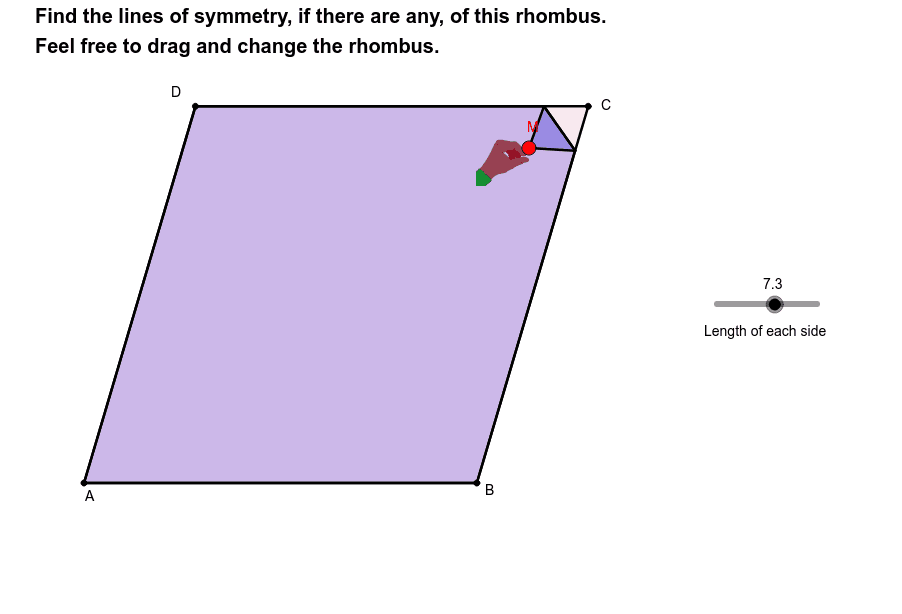
This example demonstrates the lines of symmetry for a rhombus. Key mathematical concepts include symmetry. Using GeoGebra commands such as Circle, Point, Polygon, Line, LineBisector, Intersect, Mirror, Midpoint, Segment, If, etc., a rhombus is constructed and its lines of symmetry are observed. Suitable for students at the middle school level and above to learn about symmetry.
GeoGebra Commands & Parameters
Circle(A, a) → d1Point(d1) → DPolygon(A, B, C, D) → poly1, a_1, b_1, d_1, c_1Line(C, B) → jLine(D, C) → kLine(A, B) → lLine(D, A) → mLineBisector(M, C) → cIntersect(c, k) → F_1Intersect(c, l) → GIntersect(c, m) → HIntersect(j, c) → IMirror(B, c) → B'Mirror(D, c) → D'Mirror(A, c) → A'Polygon(M, F_1, I) → poly2, i, e, fPolygon(F_1, D, A, B, I) → poly3, f_1, d, a_2, b_2, i_1Polygon(F_1, M, B', G) → poly4, f_2, e_1, b', gPolygon(F_1, D, A, G) → poly5, f_3, d_2, a_3, g_1Polygon(F_1, M, B', A', H) → poly6, f_4, e_2, b'_1, a', hPolygon(F_1, D, H) → poly7, h_1, f_5, d_3Polygon(H, D', M, I) → poly8, h_2, d', e_3, i_2Polygon(H, A, B, I) → poly9, h_3, a_4, b_3, i_3Polygon(H, D', M, B', G) → poly10, h_4, d'_1, e_4, b'_2, g_2Polygon(H, A, G) → poly11, g_3, h_5, a_5Polygon(G, B, I) → poly13, i_4, g_4, b_4Polygon(G, A', D', M, I) → poly12, n, p, q, r, sMidpoint(D, C) → EMidpoint(A, B) → FSegment(E, F) → tIf(Distance[M, D] ≤ 0.05, 1, 0) → okMidpoint(C, M) → JMidpoint(b_1) → KMidpoint(c_1) → LLine(D, B) → bLine(D, B) → c1
AI Drawing Prompt Reference
Draw a rhombus and find its lines of symmetry. Start by drawing a circle and taking a point on the circle as one vertex of the rhombus. Then, use this point and the other three points to form the rhombus. Next, draw the diagonals of the rhombus, which intersect at the center of the rhombus. Finally, draw the lines passing through the center; these are the lines of symmetry of the rhombus.
The prompt above was compiled from the original drawing commands and is for reference only.