
Linear Combination of Vectors by Kevin Hopkins
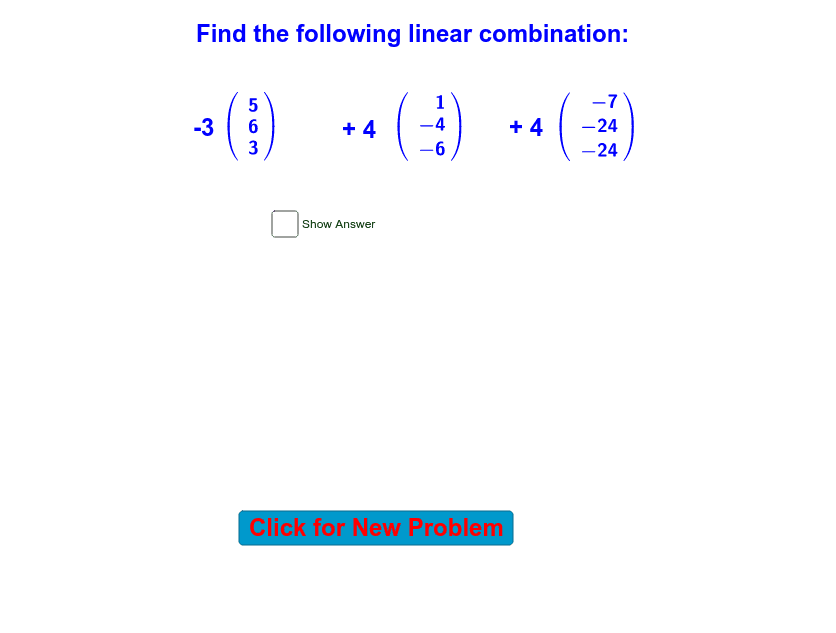
Loading the math board and drawing, please wait…
In collections
Linear Algebra
This example demonstrates how to find the linear combination of given vectors with specified coefficients. Key math concepts include vector addition, linear combinations, and coordinate transformations. Construction highlights involve using commands like Random, Transpose, and Element to manipulate vector components, with LaTeX for formula display. Objects such as di, uh, vh, uv, vv, iwh, iwv, c1, c2, c3, vorh, dwh, dwv, u, v, w, lc, text1, text2, text3, text4, text5, button1, text5_2, text5_1, ans, text6, a, text7, text8, text9 are utilized. Suitable for high school and above students studying vectors and linear algebra.
GeoGebra Commands & Parameters
Random(1, 2) → diTranspose({uh}) → uvTranspose({vh}) → vvTranspose({iwh}) → iwvRandom(1, 2) → vorhTranspose({dwh}) → dwvElement({uh, uv}, vorh) → uElement({vh, vv}, vorh) → vElement({{dwh, dwv}, {iwh, iwv}}, di, vorh) → wLaTeX(u) → text2LaTeX(v) → text3LaTeX(w) → text4LaTeX(ans) → text6
AI Drawing Prompt Reference
Draw a vector linear combination diagram showing two vectors combined with random coefficients, using coordinate transformations and vector addition to find the resultant vector, with LaTeX formulas labeling the vector coordinates, and the final image includes the original vectors, the combination vector, and formula text.
The prompt above was compiled from the original drawing commands and is for reference only.