
Laws of Exponents 3: Power of a Power
Loading the math board and drawing, please wait…
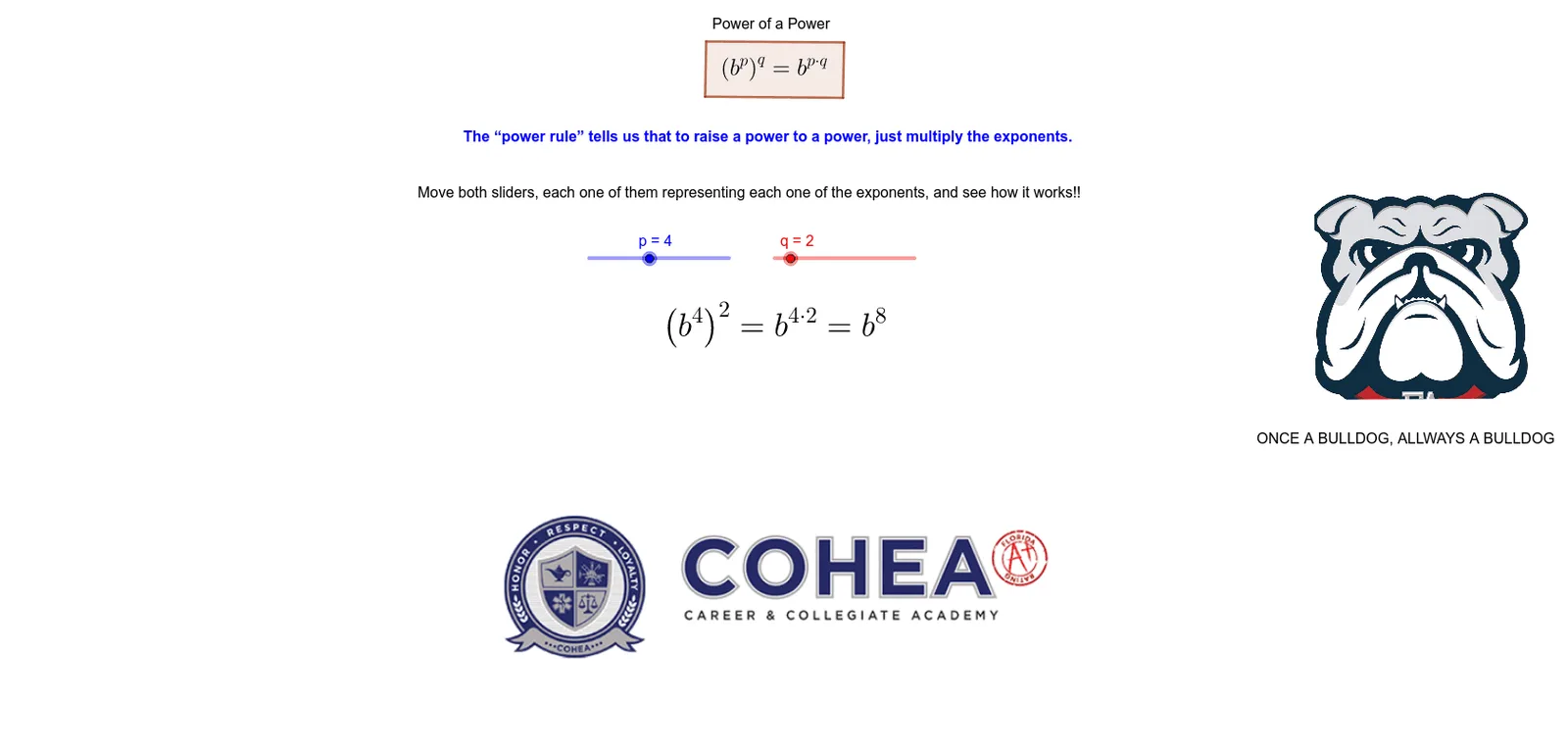
This GeoGebra example dynamically demonstrates the 'power of a power' rule in exponent arithmetic, i.e., (a^m)^n = a^(m·n). It uses polygons, text labels, and images to create a visual teaching scenario that helps learners intuitively grasp the law of multiplying exponents. Core mathematical concepts include exponent operations, powers, algebraic identities, and the integration of numbers and shapes. Construction highlights: from the summary, the Polygon command is used to create polygons, and numerous text objects (texto1, texto7, etc.) label formulas and explanations. Points (A, B, C, D, E, F, G, H, I, J), segments (a, b, c, d, e), a circle (c1), images (imagen1, imagen2), and solid geometry elements (Archimedean, Pyramid, Prism) are included, possibly to illustrate analogies between exponential growth and geometric volumes. Suitable for middle and high school students learning exponent rules, as well as for teacher demonstrations or self-exploration, allowing users to adjust parameters to observe changes and deepen understanding of algebraic rules.
GeoGebra Commands & Parameters
Polygon(A, B, C, D) → c1, a_1, b, c, d
AI Drawing Prompt Reference
Create an educational diagram illustrating the power of a power rule in exponents. Place a quadrilateral in the center, filled with distinct colors to represent the base geometrically. Around it, add multiple text boxes showing example formulas, such as "(a^m)^n = a^(m·n)", with arrows or connecting lines indicating the derivation. On one side, include a circle and several line segments to symbolize the analogy between exponential growth and geometric volume. The layout should be clear, combining text and shapes, suitable for classroom demonstration to help understand exponent operations.
The prompt above was compiled from the original drawing commands and is for reference only.