
Law of Small Numbers
Loading the math board and drawing, please wait…
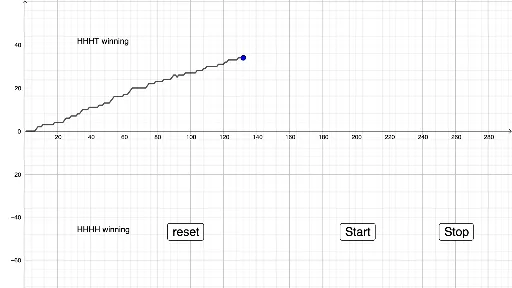
This example illustrates the law of small numbers, where small samples may show significant differences from large samples in random experiments. Key concepts include probability, random experiments, random variables, and stochastic processes. Using GeoGebra commands such as Sequence, IndexOf, If, Sum, and PolyLine, the example simulates multiple coin flips and observes the frequency of four consecutive heads. Suitable for high school mathematics education and probability and statistics learning.
GeoGebra Commands & Parameters
Sequence(RandomElement[{"H", "T"}], w, 1, 20) → twentyFlipsSequence(twentyFlips(w) + twentyFlips(w + 1) + twentyFlips(w + 2) + twentyFlips(w + 3), w, 1, 17) → fourinarowIndexOf("HHHH", fourinarow) → indexofHHHHIndexOf("HHHT", fourinarow) → indexofHHHTIf(indexofHHHT > 0 ∧ indexofHHHH > 0 ∨ (¬Defined[indexofHHHT]) ∧ (¬Defined[indexofHHHH]), 0, If[indexofHHHT > 0, 1, -1]) → aSum(data) → bPolyLine(points) → f