
Lagrange Polynomial of Order 4
Loading the math board and drawing, please wait…
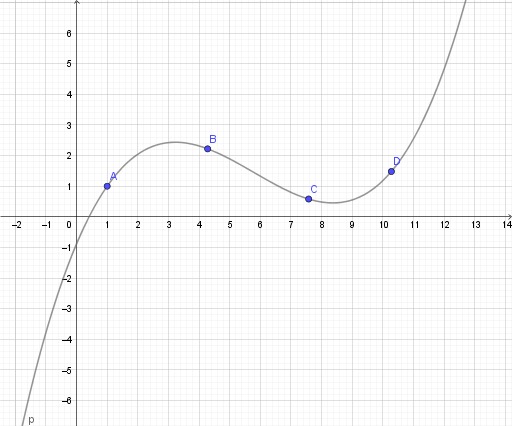
This example demonstrates the construction of a fourth-order Lagrange polynomial. It involves the concept of polynomial functions and constructs a polynomial given five points. The construction process uses GeoGebra commands such as point creation, line drawing, and polynomial generation. Suitable for high school mathematics education and learning.
GeoGebra Commands & Parameters
Point A(1.0, 1.0)Point B(4.28, 2.22)Point C(7.58, 0.58)Point D(10.28, 1.48)x(A)x(B)x(C)x(D)y(A)y(B)y(C)y(D)L1(x) = ((((x - x_2) * (x - x_3)) * (x - x_4))) / ((((x_1 - x_2) * (x_1 - x_3)) * (x_1 - x_4)))L2(x) = ((((x - x_1) * (x - x_3)) * (x - x_4))) / ((((x_2 - x_1) * (x_2 - x_3)) * (x_2 - x_4)))L3(x) = ((((x - x_1) * (x - x_2)) * (x - x_4))) / ((((x_3 - x_1) * (x_3 - x_2)) * (x_3 - x_4)))L4(x) = ((((x - x_1) * (x - x_2)) * (x - x_3))) / ((((x_4 - x_1) * (x_4 - x_2)) * (x_4 - x_3)))p(x) = (L1(x) * y_1) + (L2(x) * y_2) + (L3(x) * y_3) + (L4(x) * y_4)
AI Drawing Prompt Reference
Draw a fourth-order Lagrange interpolation polynomial with five points A(1.0, 1.0), B(4.28, 2.22), C(7.58, 0.58), D(10.28, 1.48), and an unknown point E. First, create these five points, then construct the Lagrange basis polynomials L1(x), L2(x), L3(x), and L4(x) based on these points, and finally calculate the interpolation polynomial p(x) using these basis polynomials and the y-coordinates of the points.
The prompt above was compiled from the original drawing commands and is for reference only.