
Kite with Diagonals
Loading the math board and drawing, please wait…
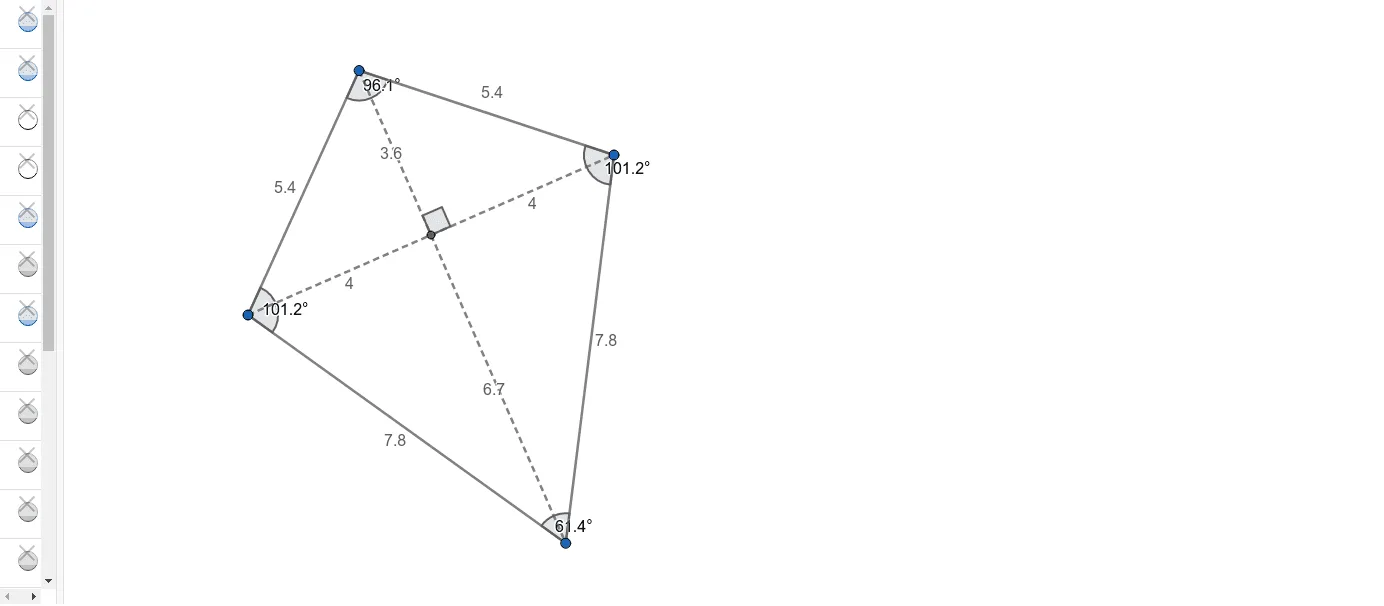
This example demonstrates a kite and its diagonals. Key mathematical concepts include the definition of a kite and the properties of its diagonals. Using GeoGebra commands such as Segment, LineBisector, Point, and Intersect, a kite can be constructed and its diagonal properties observed. Suitable for students at the junior high school level and above, focusing on geometric construction and kite properties.
GeoGebra Commands & Parameters
Segment(A, B) → fLineBisector(A, B) → gPoint(g) → CIntersect(g, f) → DPoint(g) → ESegment(A, C) → hSegment(C, B) → iSegment(B, E) → jSegment(E, A) → kSegment(A, D) → lSegment(D, B) → mSegment(D, E) → nSegment(C, D) → pAngle(B, D, C) → αAngle(E, A, C) → βAngle(A, C, B) → γAngle(C, B, E) → δAngle(B, E, A) → ε
AI Drawing Prompt Reference
Draw a quadrilateral with intersecting diagonals by first drawing points A and B, then drawing the perpendicular bisector of AB to get point C, connecting AC and CB to form a quadrilateral with intersecting diagonals, next draw diagonal DE ensuring they intersect at point D, and finally connect AE and ED to form a kite shape, observing the properties of the diagonals.
The prompt above was compiled from the original drawing commands and is for reference only.