
Kite & Rhombus Exploration
Loading the math board and drawing, please wait…
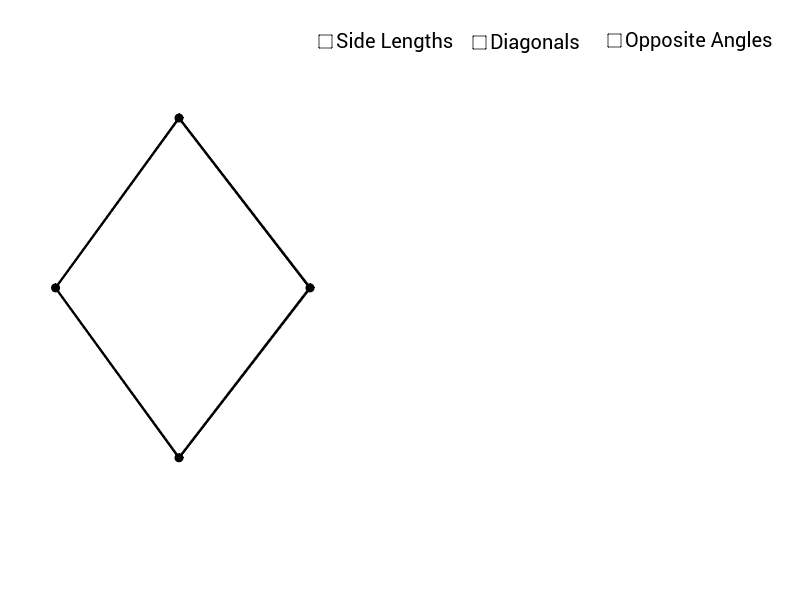
① This applet dynamically explores the properties of kites as an extension of rhombus properties, visually demonstrating how a kite relates to a rhombus. ② Core mathematical concepts include kite symmetry, perpendicular diagonals, adjacent side equality, and the inclusion of rhombus as a special kite, covering polygons, angles, and reflection transformations. ③ Construction details: Based on the summary, the applet uses GeoGebra commands such as Line, Mirror, Point, Segment, Angle, and Intersect, creating objects A, B, C, D, E, F and multiple auxiliary points, segments, and angles (α, β, γ, δ, etc.), using mirroring and intersection to form the kite and measure its angles and side relationships. ④ Suitable for middle school to high school students for geometric property investigation, and useful for teachers as a classroom demonstration tool to understand quadrilateral classification and property derivation.
GeoGebra Commands & Parameters
Line(A, B) → aMirror(C, a) → C'Point(a) → DPoint(a) → ESegment(D, C) → bSegment(C, E) → cSegment(E, C') → dSegment(C', D) → eSegment(C, C') → fSegment(D, E) → gAngle(C', D, C) → αAngle(D, C, E) → βAngle(C, E, C') → γAngle(E, C', D) → δAngle(E, D, C) → εAngle(D, C, C') → ζAngle(C', C, E) → ηAngle(C, E, D) → θAngle(D, E, C') → ιAngle(E, C', C) → κAngle(C, C', D) → λAngle(C', D, E) → μIntersect(g, f) → FAngle(E, F, C) → νSegment(D, C) → kSegment(C, E) → lSegment(E, C') → mSegment(C', D) → nSegment(C, F) → qSegment(F, C') → rSegment(F, D) → sSegment(F, E) → t
AI Drawing Prompt Reference
Draw a kite shape with points A, B, C, D, E, F. The construction starts by drawing line AB. Then mirror point C across AB to get C'. Points D and E are placed on AB. Connect C, D, E, C' to form the kite. Measure angles such as alpha, beta, gamma, delta. Finally, find point F by intersecting segments g and f, and connect F to other points to complete the shape.
The prompt above was compiled from the original drawing commands and is for reference only.