
Kayleigh Kearsley Intersecting Planes
Loading the math board and drawing, please wait…
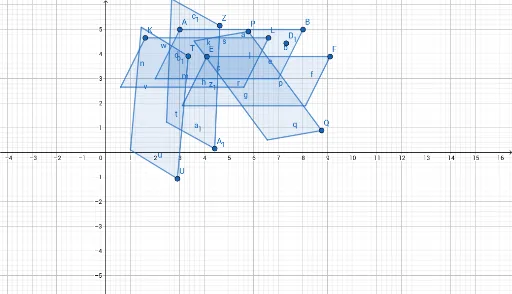
This example demonstrates the geometric relationships between three intersecting planes and their lines of intersection. Core math concepts include spatial geometry, plane equations, polygon construction, and rotation transformations. Construction involves commands like Point, Polygon, and Rotate. Suitable for high school geometry teaching and construction practice.
GeoGebra Commands & Parameters
Point(Circle[A, 5]) → BPolygon(A, B, C, D) → q1, a, b, c, dPoint(Circle[E, Segment[A, B]]) → FRotate(F + (Segment[B, C], 0), Angle[C - B] + Angle[F - E] - Angle[B - A], F) → GRotate(G + (Segment[C, D], 0), Angle[D - C] + Angle[G - F] - Angle[C - B], G) → HPolygon(E, F, G, H) → q2, e, f, g, hPoint(Circle[K, Segment[E, F]]) → LRotate(L + (Segment[F, G], 0), Angle[G - F] + Angle[L - K] - Angle[F - E], L) → MRotate(M + (Segment[G, H], 0), Angle[H - G] + Angle[M - L] - Angle[G - F], M) → NPolygon(K, L, M, N) → q3, k, l, m, nPoint(Circle[P, Segment[A, B]]) → QRotate(Q + (Segment[B, C], 0), Angle[C - B] + Angle[Q - P] - Angle[B - A], Q) → RRotate(R + (Segment[C, D], 0), Angle[D - C] + Angle[R - Q] - Angle[C - B], R) → SPolygon(P, Q, R, S) → q4, p, q, r, sPoint(Circle[T, Segment[A, B]]) → URotate(U + (Segment[B, C], 0), Angle[C - B] + Angle[U - T] - Angle[B - A], U) → VRotate(V + (Segment[C, D], 0), Angle[D - C] + Angle[V - U] - Angle[C - B], V) → WPolygon(T, U, V, W) → q5, t, u, v, wPoint(Circle[Z, Segment[A, B]]) → A_1Rotate(A_1 + (Segment[B, C], 0), Angle[C - B] + Angle[A_1 - Z] - Angle[B - A], A_1) → B_1Rotate(B_1 + (Segment[C, D], 0), Angle[D - C] + Angle[B_1 - A_1] - Angle[C - B], B_1) → C_1Polygon(Z, A_1, B_1, C_1) → q6, z_1, a_1, b_1, c_1
AI Drawing Prompt Reference
Create a 3D geometric figure consisting of six quadrilateral planes, with three main planes intersecting each other to form spatial intersection lines. Each plane is defined by four vertices, generated through successive rotations along adjacent edges, causing the planes to twist and interlock. The figure includes multiple similar but differently positioned quadrilaterals arranged around a central region, demonstrating how planes intersect and rotate in space. The overall composition emphasizes geometric transformations and spatial symmetry, suitable for high school solid geometry teaching.
The prompt above was compiled from the original drawing commands and is for reference only.