
Isosceles Trapezoids by Courtney O'Berry
Loading the math board and drawing, please wait…
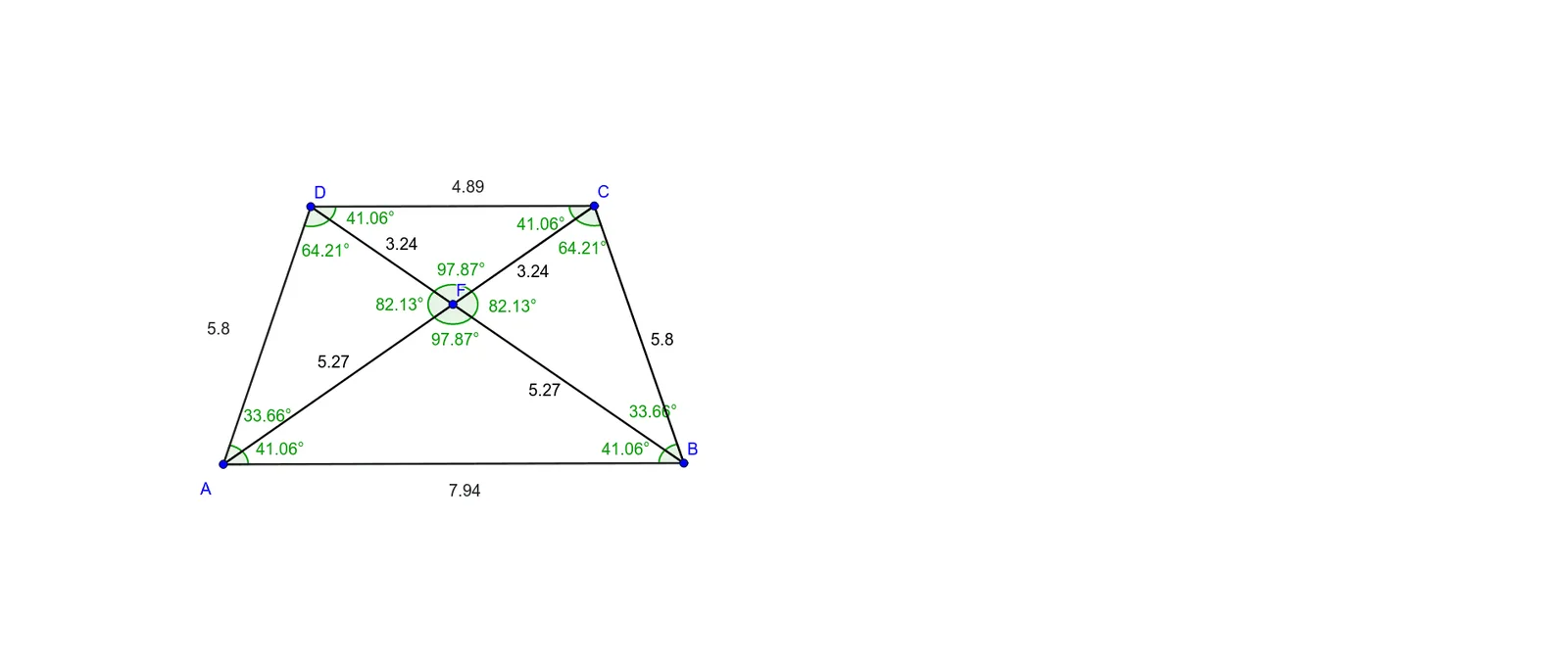
This example demonstrates the geometric construction and properties of isosceles trapezoids. It involves core math concepts like polygons, angles, geometric construction, and coordinate geometry. Key GeoGebra commands used include Line, Segment, LineBisector, Intersect, Mirror, Polygon, and Angle. Suitable for high school mathematics teaching or geometric construction learning.
GeoGebra Commands & Parameters
Line(A, B) → fLine(D, f) → gSegment(A, D) → hLineBisector(A, B) → iIntersect(g, i) → EMirror(D, E) → CSegment(C, B) → jPolygon(A, B, C, D) → q1, a, b, c, dSegment(A, C) → kSegment(D, B) → lIntersect(k, l) → FSegment(D, F) → mSegment(F, C) → nSegment(F, B) → pSegment(F, A) → qAngle(A, D, F) → αAngle(D, F, A) → βAngle(F, A, D) → γAngle(F, D, C) → δAngle(D, C, F) → εAngle(C, F, D) → ζAngle(B, F, C) → ηAngle(F, C, B) → θAngle(C, B, F) → ιAngle(A, F, B) → κAngle(F, B, A) → λAngle(B, A, F) → μ
AI Drawing Prompt Reference
Draw an isosceles trapezoid by first creating two parallel line segments, then finding the perpendicular bisector of one segment that intersects the other parallel line. Mirror one endpoint across this intersection to form the trapezoid, and label all interior angles.
The prompt above was compiled from the original drawing commands and is for reference only.