
Isosceles Trapezoid (Scaffolded Discovery)
Loading the math board and drawing, please wait…
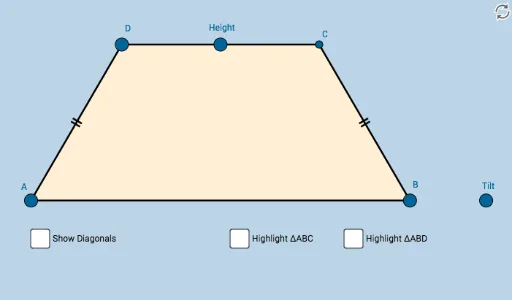
This example demonstrates the geometric properties and transformations of an isosceles trapezoid. Core concepts include polygons, similarity transformations, linear equations, and geometric constructions. It utilizes commands like Line, Ray, Point, Midpoint, Slope, OrthogonalLine, Mirror, Dilate, Segment, Circle, Intersect, Vector, Translate, Angle, Rotate, Polygon, Distance. Suitable for high school mathematics education to explore symmetry and transformation patterns of isosceles trapezoids.
GeoGebra Commands & Parameters
Line(A, B_1) → aRay(A, B_1) → bPoint(b) → BMidpoint(A, B) → D_1Line(A, B) → cSlope(c) → dOrthogonalLine(D_1, c) → gPoint(g) → E_1Ray(D_1, E_1) → hPoint(h) → FSlope(h) → iLine(F, c) → lPoint(l) → GPoint(l) → HRay(F, G) → mRay(F, H) → nPoint(m) → DMirror(D, h) → I'Dilate(A, If[0 < o ≤ 1, 1 - o, 0], B) → A'Segment(A, A') → pDilate(A, If[1 < o ≤ 2, 2 - o, 0], D) → A'_1Segment(A, A'_1) → qSegment(A, B) → rSegment(B, I') → sSegment(I', D) → tSegment(D, A) → a_1Circle(A, (0.2 * Min[a_1, r])) → c_1Circle(D, (0.2 * Min[a_1, r])) → d_1Intersect(d_1, a_1, 1) → JIntersect(d_1, t, 1) → KIntersect(c_1, r, 1) → LIntersect(c_1, a_1, 1) → MDilate(D, If[2 < o ≤ 3, 3 - o, 0], I') → I'_1Segment(D, I'_1) → b_1Dilate(A, If[3 < o ≤ 4, 4 - o, 0], B) → A'_2Vector(A, A'_2) → uTranslate(A, u) → A'_3Translate(A'_1, u) → NSegment(A'_3, N) → q'OrthogonalLine(A, r) → g_1Point(g_1) → OAngle(D, A, O) → αAngle(I', B, A) → βRotate(A'_3, If[4 < o ≤ 5, (((o - 4) * 2) * α), (2 * α)], B) → PRotate(N, If[4 < o ≤ 5, (((o - 4) * 2) * α), (2 * α)], B) → CSegment(P, C) → q''Dilate(A, If[5 < o ≤ 6, 6 - o, 0], B) → A'_4Vector(A, A'_4) → vDilate(D, If[7 < o ≤ 8, 8 - o, 0], I') → I'_2Vector(D, I'_2) → wDilate(A, If[9 < o ≤ 10, 10 - o, 0], I') → A'_5Segment(A, A'_5) → i_1Dilate(A, If[10 < o ≤ 11, 11 - o, 0], D) → A'_6Vector(A, A'_6) → u_1Translate(A, u_1) → A'_7Translate(A'_5, u_1) → QSegment(A'_7, Q) → j_1Segment(D, B) → l_1Angle(L, A, I') → γRotate(A'_7, If[11 < o ≤ 12, ((-(o - 11)) * (2 * γ)), (-2 * γ)], D) → RRotate(Q, If[11 < o ≤ 12, ((-(o - 11)) * (2 * γ)), (-2 * γ)], D) → Q'Segment(R, Q') → m_1Polygon(A, B, I', D) → poly1, a_2, c_2, i', i_2Intersect(i_1, m_1) → EDistance(A, E) → distanceASDistance(E, C) → distanceSN'Distance(E, B) → distanceSCDistance(E, D) → distanceSIAngle(B, A, E) → δAngle(E, B, A) → εAngle(C, B, E) → ζAngle(E, A, D) → ηAngle(A, D, E) → θAngle(E, D, C) → ιAngle(D, C, E) → κAngle(B, E, C) → λAngle(E, C, B) → μAngle(A, E, B) → νPolygon(A, B, C) → poly2, c_3, a_3, b_2Segment(A, C) → h_1Mirror(A, h_1) → A'_8Mirror(B, h_1) → B'Mirror(C, h_1) → C'Polygon(A'_8, B', C') → poly2', c', a'_8, b'Polygon(D, A, B) → poly3, b_3, d_2, a_4Segment(D, B) → p_1Mirror(D, p_1) → D'Mirror(A, p_1) → A'_9Mirror(B, p_1) → B'_1Polygon(D', A'_9, B'_1) → poly3', b'_1, d', a'_9