
Isosceles Trapezoid Midpoints Form a Rhombus: Coordinate Geometry Proof
Loading the math board and drawing, please wait…
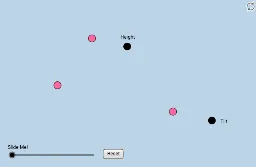
This GeoGebra example demonstrates that the midpoints of the four sides of an isosceles trapezoid, when connected in order, form a rhombus. It serves as a coordinate geometry proof prompt. Core concepts include properties of isosceles trapezoids (equal legs, base angles, symmetry), midpoint coordinates, rhombus criteria (equal side lengths or perpendicular bisecting diagonals), and distance formulas in the Cartesian plane. The construction uses GeoGebra commands such as Line, Ray, Point, Midpoint, Slope, OrthogonalLine, Mirror, Dilate, Segment, Circle, Intersect, Vector, Translate, Angle, Rotate, and Polygon to build the trapezoid, locate midpoints, and verify the resulting quadrilateral. Suitable for high school geometry or coordinate geometry classes, this interactive applet helps students visualize the theorem and develop algebraic proof skills.
GeoGebra Commands & Parameters
Line(A, B) → aRay(A, B) → bPoint(b) → CMidpoint(A, C) → DLine(A, C) → cSlope(c) → dOrthogonalLine(D, c) → gPoint(g) → ERay(D, E) → hPoint(h) → FSlope(h) → iLine(F, c) → lPoint(l) → GPoint(l) → HRay(F, G) → mRay(F, H) → nPoint(m) → IMirror(I, h) → I'Dilate(A, If[0 < o ≤ 1, 1 - o, 0], C) → A'Segment(A, A') → pDilate(A, If[1 < o ≤ 2, 2 - o, 0], I) → A'_1Segment(A, A'_1) → qSegment(A, C) → rSegment(C, I') → sSegment(I', I) → tSegment(I, A) → a_1Circle(A, (0.2 * Min[a_1, r])) → c_1Circle(I, (0.2 * Min[a_1, r])) → d_1Intersect(d_1, a_1, 1) → JIntersect(d_1, t, 1) → KIntersect(c_1, r, 1) → LIntersect(c_1, a_1, 1) → MDilate(I, If[2 < o ≤ 3, 3 - o, 0], I') → I'_1Segment(I, I'_1) → b_1Dilate(A, If[3 < o ≤ 4, 4 - o, 0], C) → A'_2Vector(A, A'_2) → uTranslate(A, u) → A'_3Translate(A'_1, u) → NSegment(A'_3, N) → q'OrthogonalLine(A, r) → g_1Point(g_1) → OAngle(I, A, O) → αAngle(I', C, A) → βRotate(A'_3, If[4 < o ≤ 5, (((o - 4) * 2) * α), (2 * α)], C) → PRotate(N, If[4 < o ≤ 5, (((o - 4) * 2) * α), (2 * α)], C) → N'Segment(P, N') → q''Dilate(A, If[5 < o ≤ 6, 6 - o, 0], C) → A'_4Vector(A, A'_4) → vDilate(I, If[7 < o ≤ 8, 8 - o, 0], I') → I'_2Vector(I, I'_2) → wDilate(A, If[5 < o ≤ 6, 6 - o, 0], I') → A'_5Dilate(A, If[6 < o ≤ 7, 7 - o, 0], I) → A'_6Vector(A, A'_6) → u_1Translate(A, u_1) → A'_7Translate(A'_5, u_1) → QSegment(I, C) → l_1Angle(L, A, I') → γRotate(A'_7, If[11 < o ≤ 12, ((-(o - 11)) * (2 * γ)), (-2 * γ)], I) → RRotate(Q, If[7 < o ≤ 8, (((-(o - 7)) * 2) * γ), (-2 * γ)], I) → Q'Polygon(A, C, I', I) → poly1, a_2, c_2, i', i_2Midpoint(a_1) → SMidpoint(t) → TMidpoint(s) → UMidpoint(r) → VDilate(A, If[5.5 < o ≤ 6.5, 6.5 - o, 0], S) → A'_8Dilate(I, If[5.5 < o ≤ 6.5, 6.5 - o, 0], T) → I'_3Dilate(I', If[5.5 < o ≤ 6.5, 6.5 - o, 0], U) → I''Dilate(C, If[5.5 < o ≤ 6.5, 6.5 - o, 0], V) → C'Segment(A, A'_8) → f_1Segment(I, I'_3) → h_1Segment(I', I'') → i_1Segment(C, C') → j_1Rotate(A, If[6.5 < o ≤ 7.5, ((-(o - 6.5)) * π), (-π)], S) → A'_9Rotate(A'_8, If[6.5 < o ≤ 7.5, ((-(o - 6.5)) * π), (-π)], S) → WSegment(A'_9, W) → k_1Rotate(I, If[6.5 < o ≤ 7.5, ((-(o - 6.5)) * π), (-π)], T) → I'_4Rotate(I'_3, If[6.5 < o ≤ 7.5, ((-(o - 6.5)) * π), (-π)], T) → ZSegment(I'_4, Z) → m_1Rotate(I', If[6.5 < o ≤ 7.5, ((-(o - 6.5)) * π), (-π)], U) → I''_1Rotate(I'', If[6.5 < o ≤ 7.5, ((-(o - 6.5)) * π), (-π)], U) → I'''Segment(I''_1, I''') → n_1Rotate(C, If[6.5 < o ≤ 7.5, ((-(o - 6.5)) * π), (-π)], V) → C'_1Rotate(C', If[6.5 < o ≤ 7.5, ((-(o - 6.5)) * π), (-π)], V) → C''Segment(C'_1, C'') → p_1Dilate(V, If[7.5 < o ≤ 8.5, 8.5 - o, 0], S) → V'Segment(V, V') → q_1Angle(V, S, T) → δRotate(V, If[8.5 < o ≤ 9.5, ((o - 8.5) * δ), δ], S) → V'_1Rotate(V', If[8.5 < o ≤ 9.5, ((o - 8.5) * δ), δ], S) → V''Segment(V'_1, V'') → r_1Rotate(V'_1, If[9.5 < o ≤ 10.5, ((o - 9.5) * (π - δ)), π - δ], T) → A_1Rotate(V'', If[9.5 < o ≤ 10.5, ((o - 9.5) * (π - δ)), π - δ], T) → V'''Segment(A_1, V''') → s_1Rotate(A_1, If[10.5 < o ≤ 11.5, ((o - 10.5) * δ), δ], U) → B_1Rotate(V''', If[10.5 < o ≤ 11.5, ((o - 10.5) * δ), δ], U) → C_1Segment(B_1, C_1) → t_1Polygon(A, V, S) → poly2, s_2, a_3, v_1Polygon(S, I, T) → poly3, t_2, s_3, i_3Polygon(T, U, I') → poly4, i'_1, t_3, u_2Polygon(V, C, U) → poly5, u_3, v_2, c_3Polygon(V, U, T, S) → poly6, v_3, u_4, t_4, s_4
AI Drawing Prompt Reference
Draw an isosceles trapezoid ABCD, then find the midpoints E and F of sides AB and CD, respectively. Connect E and F to form a quadrilateral EFGH. Verify that EFGH is a rhombus.
The prompt above was compiled from the original drawing commands and is for reference only.