
Isosceles Trapezoid Properties: Dynamic Geometry and Proofs
Loading the math board and drawing, please wait…
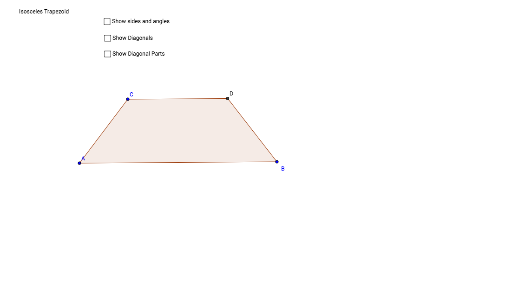
This GeoGebra example dynamically demonstrates the core geometric properties of an isosceles trapezoid, focusing on key features such as equal base angles, equal diagonal lengths, and axial symmetry. Core mathematical concepts include the definition of isosceles trapezoids, congruent triangles, diagonal properties, and symmetry-based geometric proofs. To construct this model, the tool utilizes the `Segment` and `Line` commands to establish the basic geometric framework, `Angle` and `Rotate` commands to precisely define symmetric vertices and base angles, `Intersect` to locate key vertices, and `Polygon` to render the main trapezoid `poly1`. Auxiliary objects like altitude `h`, diagonals `BC` and `AD`, and text labels `text1` are integrated to visualize and annotate geometric relationships. This resource is highly suitable for secondary school geometry lessons, math competition preparation, and interactive teacher demonstrations.
GeoGebra Commands & Parameters
Segment(A, B) → aLine(C, a) → bSegment(C, A) → cAngle(B, A, C) → αRotate(A, (-α), B) → A'Angle(A', B, A) → βLine(A', B) → dIntersect(b, d) → DSegment(D, B) → eSegment(D, C) → fAngle(A, C, D) → γAngle(C, D, B) → δPolygon(A, C, D, B) → poly1, a_1, c_1, d_1, b_1Segment(C, B) → BCSegment(D, A) → ADIntersect(BC, AD) → ESegment(C, E) → iSegment(E, D) → jSegment(E, B) → kSegment(E, A) → l