
Isosceles Trapezoid Exploration by Tim Brzezinski
Loading the math board and drawing, please wait…
In collections
Congruence (CO) Cluster
Congruence (Vol 2)
CCSS High School: Geometry (Congruence) Volume 2
CCSS High School: Geometry (Congruence) Volume 2
CCSS High School: Geometry (Congruence) Volume 2
Geometry (Congruence) Volume 2
CCSS High School: Geometry (Congruence) Volume 2
CCSS High School: Geometry (Congruence) Volume 2
CCSS High School: Geometry (Congruence) Volume 2
CCSS High School: Geometry (Congruence) Volume 2
CCSS High School: Geometry (Congruence) Volume 2
CCSS High School: Geometry (Congruence) Volume 2
Gail LeBlancCCSS High School: Geometry (Congruence) Volume 2
CCSS High School: Geometry (Congruence) Volume 2
CCSS High School: Geometry (Congruence) Volume 2
Unit 7: Polygons and Quadrilaterals
Quadrilaterals
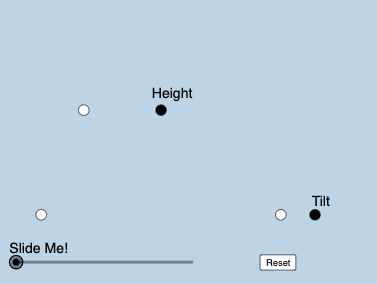
This applet allows students to informally discover properties of isosceles trapezoids with initially modifiable dimensions. Key questions follow to deepen understanding. It involves core math concepts like angles, trapezoids, and similar triangles. Constructed using commands such as Line, Point, Midpoint, Slope, Circle, Intersect, and Transformations. Ideal for middle school and above, focusing on geometric properties and dynamic visualization.
GeoGebra Commands & Parameters
Line(A, B) → aRay(A, B) → bPoint(b) → CMidpoint(A, C) → DLine(A, C) → cSlope(c) → dOrthogonalLine(D, c) → gPoint(g) → ERay(D, E) → hPoint(h) → FSlope(h) → iLine(F, c) → lPoint(l) → GPoint(l) → HRay(F, G) → mRay(F, H) → nPoint(m) → IMirror(I, h) → I'Dilate(A, If[0 < o ≤ 1, 1 - o, 0], C) → A'Segment(A, A') → pDilate(A, If[1 < o ≤ 2, 2 - o, 0], I) → A'_1Segment(A, A'_1) → qSegment(A, C) → rSegment(C, I') → sSegment(I', I) → tSegment(I, A) → a_1Circle(A, (0.2 * Min[a_1, r])) → c_1Circle(I, (0.2 * Min[a_1, r])) → d_1Intersect(d_1, a_1, 1) → JIntersect(d_1, t, 1) → KIntersect(c_1, r, 1) → LIntersect(c_1, a_1, 1) → MCircleSector(A, L, M) → e_1CircleSector(I, J, K) → f_1Dilate(I, If[2 < o ≤ 3, 3 - o, 0], I') → I'_1Segment(I, I'_1) → b_1Dilate(A, If[3 < o ≤ 4, 4 - o, 0], C) → A'_2Vector(A, A'_2) → uTranslate(A, u) → A'_3Translate(A'_1, u) → NSegment(A'_3, N) → q'OrthogonalLine(A, r) → g_1Point(g_1) → OAngle(I, A, O) → αAngle(I', C, A) → βRotate(A'_3, If[4 < o ≤ 5, (((o - 4) * 2) * α), (2 * α)], C) → PRotate(N, If[4 < o ≤ 5, (((o - 4) * 2) * α), (2 * α)], C) → N'Segment(P, N') → q''Dilate(A, If[5 < o ≤ 6, 6 - o, 0], C) → A'_4Vector(A, A'_4) → vTranslate(e_1, v) → h_1Rotate(h_1, If[6 < o ≤ 7, ((o - 6) * ((2 * α) + β)), (2 * α) + β], C) → k_1Dilate(I, If[7 < o ≤ 8, 8 - o, 0], I') → I'_2Vector(I, I'_2) → wTranslate(f_1, w) → p_1Rotate(p_1, If[8 < o ≤ 9, ((-(o - 8)) * β), (-β)], I') → q_1Dilate(A, If[9 < o ≤ 10, 10 - o, 0], I') → A'_5Segment(A, A'_5) → i_1Dilate(A, If[10 < o ≤ 11, 11 - o, 0], I) → A'_6Vector(A, A'_6) → u_1Translate(A, u_1) → A'_7Translate(A'_5, u_1) → QSegment(A'_7, Q) → j_1Segment(I, C) → l_1Angle(L, A, I') → γRotate(A'_7, If[11 < o ≤ 12, ((-(o - 11)) * (2 * γ)), (-2 * γ)], I) → RRotate(Q, If[11 < o ≤ 12, ((-(o - 11)) * (2 * γ)), (-2 * γ)], I) → Q'Segment(R, Q') → m_1Polygon(A, C, I', I) → poly1, a_2, c_2, i', i_2
AI Drawing Prompt Reference
Draw an isosceles trapezoid by first drawing a line segment AB as the base. Extend the base to point C and draw AC as one of the non-parallel sides. Find the midpoint D of AC and draw a perpendicular line through D, intersecting the extended AC at point E, then draw DE. Extend DE to point F and draw a parallel line through F, intersecting the extended AC at point G, then draw FG. Extend FG to point H and draw a parallel line through H, intersecting the extended AC at point I, then draw HI. Draw a circle with center I and radius HI, intersecting the extended AC at points J and K, draw circles with centers A and I, intersecting the extended AC at points L and M, then draw two circular sectors. Draw a line through I and I', intersecting the extended AC at point O, then draw angles ∠IAO and ∠I'CA, draw a line through A' and C, intersecting the extended AC at point P, draw a line through N, intersecting the extended AC at point N', then draw line segments P and N'.
The prompt above was compiled from the original drawing commands and is for reference only.