
Refraction Prism: Light Path and Angle Relationships
Loading the math board and drawing, please wait…
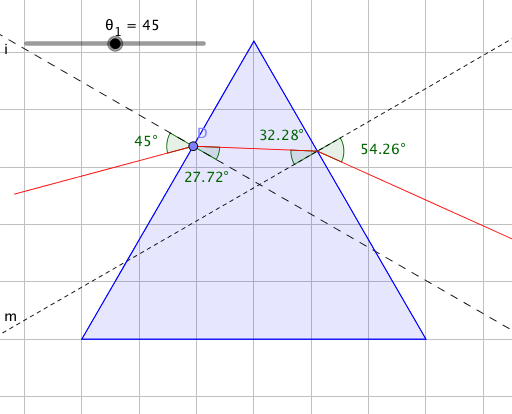
This GeoGebra example demonstrates the path of light through a triangular prism, showing how the incident angle, internal refraction angle, and emergent angle relate. It illustrates Snell's law and geometric optics, involving trigonometric functions, angle measurement, and intersection of lines with polygons. The construction uses commands such as Point, Polygon, OrthogonalLine, Rotate, Angle, Segment, and Intersect to create the prism polygon (poly1), define incident ray f, normal lines, refracted rays, and compute intersection points (C, D, F, G, H, I) where light meets prism boundaries. Dynamic sliders adjust angles (θ_1, θ_2, θ_4) to explore refraction behavior. Suitable for high school physics or mathematics classes studying refraction, trigonometry, and dynamic geometry.
GeoGebra Commands & Parameters
Point(yAxis) → BPoint(xAxis) → APolygon(A, B, 3) → poly1, f, g, h, CPoint(h) → DOrthogonalLine(D, h) → iPoint(i) → FPoint(i) → ERotate(E, (θ_1 * π / 180), D) → E'Angle(E, D, E') → θ_{incident}Rotate(F, θ_2, D) → F'Angle(F, D, F') → θ_{inside}Segment(E', D) → jSegment(D, F') → kIntersect(g, k) → GSegment(D, G) → lOrthogonalLine(G, g) → mPoint(m) → HAngle(D, G, H) → θ_{next}Point(m) → IRotate(I, θ_4, G) → I'Rotate(I, (-θ_4), G) → I'_1Angle(I'_1, G, I) → θ_{out}Segment(G, I'_1) → n