
Exterior Angles of Polygons by Nancy Lively
Loading the math board and drawing, please wait…
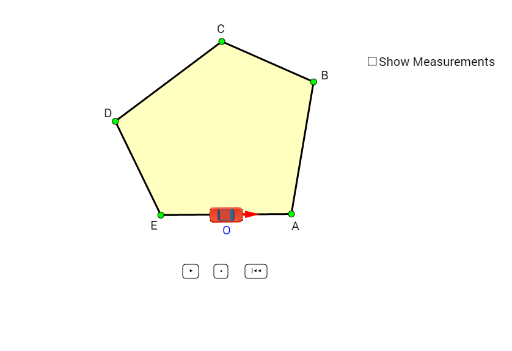
This example demonstrates the properties and calculations of exterior angles in polygons. Key mathematical concepts include the exterior angle sum theorem and the relationship between interior and exterior angles. GeoGebra commands and objects used in the construction are Rotate, Polygon, If, Vector, Angle, OrthogonalLine, Point, Midpoint, Translate, and Segment. Suitable for middle school and above mathematics learners to understand the exterior angle theorem and its practical applications.
GeoGebra Commands & Parameters
Rotate((x(P1) + (x(A) - x(E)) / Distance[E, A], y(P1) + (y(A) - y(E)) / Distance[E, A]), (Min[Max[t - 1, 0], 1] * (180° - Angle[B, A, E])), P1) → P1'Rotate((x(P2) + (x(B) - x(A)) / Distance[A, B], y(P2) + (y(B) - y(A)) / Distance[A, B]), (Min[Max[t - 3, 0], 1] * (180° - Angle[C, B, A])), P2) → P2'Rotate((x(P3) + (x(C) - x(B)) / Distance[B, C], y(P3) + (y(C) - y(B)) / Distance[B, C]), (Min[Max[t - 5, 0], 1] * (180° - Angle[D, C, B])), P3) → P3'Rotate((x(P4) + (x(D) - x(C)) / Distance[C, D], y(P4) + (y(D) - y(C)) / Distance[C, D]), (Min[Max[t - 7, 0], 1] * (180° - Angle[E, D, C])), P4) → P4'Rotate((x(P5) + (x(E) - x(D)) / Distance[E, D], y(P5) + (y(E) - y(D)) / Distance[E, D]), (Min[Max[t - 9, 0], 1] * (180° - Angle[A, E, D])), P5) → P5'Polygon(E, A, B, C, D) → poly1, a_1, b_1, c_1, d_1, e_1If(t ≤ 2, P1, If[t ≤ 4, P2, If[t ≤ 6, P3, If[t ≤ 8, P4, If[t ≤ 10, P5, P6]]]]) → PIf(t ≤ 2, P1', If[t ≤ 4, P2', If[t ≤ 6, P3', If[t ≤ 8, P4', If[t ≤ 10, P5', P6']]]]) → P'Vector(P, P') → uAngle(P1', P1, (x(P1) + (x(A) - x(E)) / Distance[E, A], y(P1) + (y(A) - y(E)) / Distance[E, A])) → αAngle(P2', P2, (x(P2) + (x(B) - x(A)) / Distance[A, B], y(P2) + (y(B) - y(A)) / Distance[A, B])) → βAngle(P3', P3, (x(P3) + (x(C) - x(B)) / Distance[B, C], y(P3) + (y(C) - y(B)) / Distance[B, C])) → γAngle(P4', P4, (x(P4) + (x(D) - x(C)) / Distance[C, D], y(P4) + (y(D) - y(C)) / Distance[C, D])) → δAngle(P5', P5, (x(P5) + (x(E) - x(D)) / Distance[E, D], y(P5) + (y(E) - y(D)) / Distance[E, D])) → εOrthogonalLine(P, u) → fPoint(f) → FMidpoint(F, P') → GVector(G, P) → vTranslate(P, v) → P'_1Translate(P', v) → P''Segment(A, (x(A) + (x(A) - x(E)) / Distance[E, A], y(A) + (y(A) - y(E)) / Distance[E, A])) → gSegment(B, (x(B) + (x(B) - x(A)) / Distance[A, B], y(B) + (y(B) - y(A)) / Distance[A, B])) → hSegment(C, (x(C) + (x(C) - x(B)) / Distance[B, C], y(C) + (y(C) - y(B)) / Distance[B, C])) → iSegment(D, (x(D) + (x(D) - x(C)) / Distance[C, D], y(D) + (y(D) - y(C)) / Distance[C, D])) → jSegment(E, (x(E) + (x(E) - x(D)) / Distance[D, E], y(E) + (y(E) - y(D)) / Distance[D, E])) → kMidpoint(a_1) → OAngle((x(A) + (x(A) - x(E)) / Distance[E, A], y(A) + (y(A) - y(E)) / Distance[E, A]), A, B) → aAngle((x(B) + (x(B) - x(A)) / Distance[A, B], y(B) + (y(B) - y(A)) / Distance[A, B]), B, C) → bAngle((x(C) + (x(C) - x(B)) / Distance[B, C], y(C) + (y(C) - y(B)) / Distance[B, C]), C, D) → cAngle((x(D) + (x(D) - x(C)) / Distance[C, D], y(D) + (y(D) - y(C)) / Distance[C, D]), D, E) → dAngle((x(E) + (x(E) - x(D)) / Distance[D, E], y(E) + (y(E) - y(D)) / Distance[D, E]), E, A) → eIf((t ≥ 1) ∧ (t < 2), α, If[t ≥ 2, a, 0°]) → α'If((t ≥ 3) ∧ (t < 4), β, If[t ≥ 4, b, 0°]) → β'If((t ≥ 5) ∧ (t < 6), γ, If[t ≥ 6, c, 0°]) → γ'If((t ≥ 7) ∧ (t < 8), δ, If[t ≥ 7, d, 0°]) → δ'If((t ≥ 9) ∧ (t < 10), ε, If[t ≥ 9, e, 0°]) → ε'
AI Drawing Prompt Reference
Draw a pentagon ABCDE and rotate each vertex to generate new points P1' to P5'. Draw a new pentagon P1'P2'P3'P4'P5' using these points. Extend each side of the pentagon and draw vectors u. Calculate each exterior angle and generate new points P' through rotation. Draw vector v and translate points P and P' to generate P'_1 and P''. Draw the sides and diagonals of pentagon ABCDE and label the degree of each exterior angle.
The prompt above was compiled from the original drawing commands and is for reference only.