
Isosceles and Equilateral Triangles
Loading the math board and drawing, please wait…
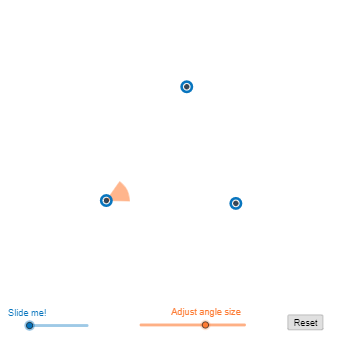
This example demonstrates the properties and relationships of isosceles and equilateral triangles. It involves core mathematical concepts such as angles, sides, symmetry, and congruent triangles. Construction highlights include using commands like Rotate, Angle, Ray, Point, Intersect, Segment, Polygon, Circle, CircleSector, Dilate, Vector, and Translate in GeoGebra. Suitable for middle school students and above for learning geometric properties and construction methods, or for classroom demonstrations.
GeoGebra Commands & Parameters
Rotate(B, (-α), A) → B'Angle(B', A, B) → βRay(A, B') → fPoint(f) → CRotate(A, (-α), C) → A'Angle(A', C, A) → γRay(C, A') → gRay(A, B) → hIntersect(g, h) → DSegment(A, D) → iSegment(C, D) → jSegment(A, C) → kPolygon(A, C, D) → poly1, d, a, cMin(i, k) → eCircle(A, (0.2 * e)) → pIntersect(p, k, 1) → EIntersect(p, i, 1) → FCircleSector(A, E, F) → qDilate(A, If[0 < b ≤ 1, 1 - b, 0], C) → A'_1Segment(A, A'_1) → lVector(A, A'_1) → uTranslate(q, u) → q'Rotate(q', If[1 < b ≤ 2, ((b - 1) * (π - α)), π - α], C) → q''Dilate(A, If[2 < b ≤ 3, 3 - b, 0], D) → A'_2Dilate(C, If[2 < b ≤ 3, 3 - b, 0], D) → C'Segment(A, A'_2) → mSegment(C, C') → nRotate(A, If[3.5 < b ≤ 4.5, ((b - 3.5) * (π - (2 * α))), π - (2 * α)], D) → A'_3Rotate(A'_2, If[3.5 < b ≤ 4.5, ((b - 3.5) * (π - (2 * α))), π - (2 * α)], D) → GSegment(A'_3, G) → m'
AI Drawing Prompt Reference
In the plane, start with a given point A and point B. Construct a new point A′ by rotating A about B using a fixed angle α, then form an angle at A between rays through A′ and B′. Use rays from A and from C to determine their intersection point D. Draw the segments AD, CD, and AC to form triangle ACD. Next, construct a circle centered at A with a radius based on the minimum of AD and AC, intersect this circle with AC and AD to obtain points E and F, and use these to form a circle sector at A. Translate the sector by the vector from A to A′1, then rotate the translated sector about C by an angle related to α. Finally, dilate points relative to D and C to obtain A′2 and C′, draw segments AA′2 and CC′, and rotate around D to create an additional point G with the segment between A′3 and G, yielding a diagram emphasizing isosceles and equilateral triangle relationships.
The prompt above was compiled from the original drawing commands and is for reference only.