
Investigation of Isosceles Trapezoid Properties
Loading the math board and drawing, please wait…
In collections
Quadrilateral Investigation
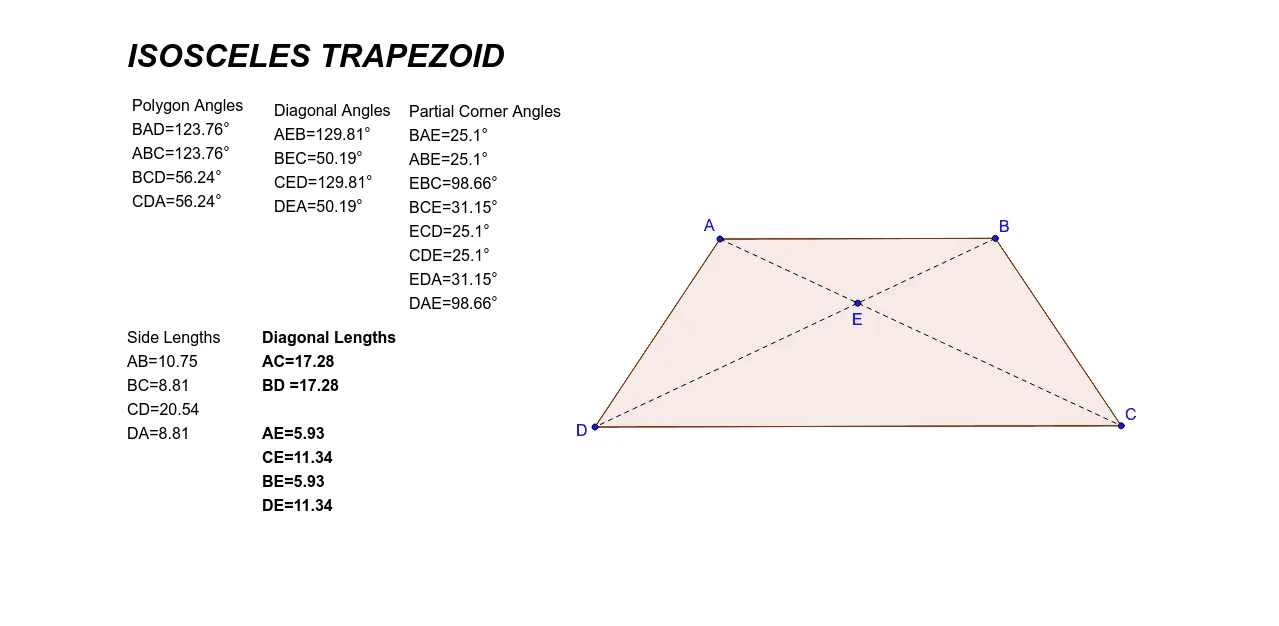
This example explores the properties of an isosceles trapezoid by measuring its sides, angles, and diagonals. Key mathematical concepts include the definition of an isosceles trapezoid, relationships between side lengths, angle measures, and diagonal properties. GeoGebra commands used include Segment, LineBisector, Mirror, Intersect, Distance, Polygon, and Angle. Suitable for middle school and above students to learn geometric construction and property exploration.
GeoGebra Commands & Parameters
Segment(A, D) → aSegment(D, C) → bLineBisector(b) → cMirror(A, c) → BSegment(A, B) → dSegment(B, C) → eSegment(A, C) → fSegment(B, D) → gIntersect(f, g) → EDistance(A, C) → distanceACDistance(A, E) → distanceAEDistance(C, E) → distanceCEDistance(B, E) → distanceBEDistance(D, E) → distanceDEDistance(B, D) → distanceBDPolygon(A, D, C, B) → poly1, a_1, d_1, c_1, b_1Angle(E, A, B) → αAngle(D, A, E) → βAngle(D, A, B) → γDistance(A, D) → distanceADDistance(A, B) → distanceABDistance(D, C) → distanceDCDistance(B, C) → distanceBCAngle(A, B, E) → δAngle(E, B, C) → εAngle(B, C, E) → ζAngle(E, C, D) → ηAngle(C, D, E) → θAngle(E, D, A) → ιAngle(A, B, C) → κAngle(B, C, D) → λAngle(C, D, A) → μAngle(B, E, A) → νAngle(C, E, B) → ξAngle(D, E, C) → οAngle(A, E, D) → ρ
AI Drawing Prompt Reference
Draw an isosceles trapezoid and measure its sides, diagonals, and angles. Start by drawing the two parallel bases, then find the perpendicular bisector of the top base to locate the midpoints. Use the bisector to symmetrically place the non-parallel sides. Connect the diagonals and measure their lengths. Finally, measure and label all interior angles.
The prompt above was compiled from the original drawing commands and is for reference only.