
Investigating Similar Quadrilaterals
Loading the math board and drawing, please wait…
In collections
Similarity & Right Triangle Trigonometry
Similarity, Right Triangles, and Trigonometry (SRT) Cluster
Similarity Theorems!
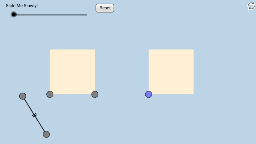
This example explores the properties of similar quadrilaterals through geometric construction. Key mathematical concepts include similarity, angles, and transformations. Commands used include Polygon, Line, Slope, Ray, Point, Circle, Distance, Intersect, CircleArc, Angle, Segment, Sequence, Dilate, Vector, Translate, Rotate. Suitable for middle school and above students or teachers.
GeoGebra Commands & Parameters
Polygon(A, B, 4) → poly1, a, b, c, d, C, DLine(A, B) → eSlope(e) → fRay(A, B) → iPoint(i) → ERay(B, E) → jPoint(j) → FCircle(F, Distance[A, B]) → kDistance(A, B) → lCircle(F, l) → pIntersect(p, j, 2) → GIntersect(p, j, 1) → HCircleArc(F, G, H) → qPoint(q) → ICircle(I, l) → rCircle(G, l) → sIntersect(r, s, 1) → JLine(A, B) → nLine(K, n) → tPoint(t) → MCircle(K, l) → c_1Intersect(c_1, t, 2) → LIntersect(c_1, t, 1) → NCircleArc(K, L, N) → d_1Point(d_1) → OAngle(M, K, O) → αSegment(K, O) → mSequence(Dilate[O, If[0 < o ≤ 1, 1 - o, 0], Element[list1, i]], i, 1, 8, 1) → list2Sequence(Vector[O, Element[list2, i]], i, 1, 8, 1) → list3Dilate(O, If[0 < o ≤ 1, 1 - o, 0], A) → O'Dilate(O, If[0 < o ≤ 1, 1 - o, 0], B) → O'_1Dilate(O, If[0 < o ≤ 1, 1 - o, 0], C) → O'_2Dilate(O, If[0 < o ≤ 1, 1 - o, 0], D) → O'_3Dilate(O, If[0 < o ≤ 1, 1 - o, 0], F) → O'_4Dilate(O, If[0 < o ≤ 1, 1 - o, 0], G) → O'_5Dilate(O, If[0 < o ≤ 1, 1 - o, 0], J) → O'_6Dilate(O, If[0 < o ≤ 1, 1 - o, 0], I) → O'_7Vector(O, O') → uVector(O, O'_1) → vVector(O, O'_2) → wVector(O, O'_3) → u_1Vector(O, O'_4) → v_1Vector(O, O'_5) → w_1Vector(O, O'_6) → a_1Vector(O, O'_7) → b_1Translate(K, u) → K'Translate(O, u) → O'_8Segment(K', O'_8) → m'Translate(K, u_1) → K'_1Translate(O, u_1) → O'_9Segment(K'_1, O'_9) → m'_1Translate(K, w) → K'_2Translate(O, w) → O'_{10}Segment(K'_2, O'_{10}) → m'_2Translate(K, v) → K'_3Translate(O, v) → O'_{11}Segment(K'_3, O'_{11}) → m'_3Translate(K, b_1) → K'_4Translate(O, b_1) → O'_{12}Segment(K'_4, O'_{12}) → m'_4Translate(K, a_1) → K'_5Translate(O, a_1) → O'_{13}Segment(K'_5, O'_{13}) → m'_5Translate(K, v_1) → K'_6Translate(O, v_1) → O'_{14}Segment(K'_6, O'_{14}) → m'_6Translate(K, w_1) → K'_7Translate(O, w_1) → O'_{15}Segment(K'_7, O'_{15}) → m'_7Rotate(K'_6, If[1 < o ≤ 2, ((o - 1) * (π - α)), π - α], F) → PRotate(O'_{14}, If[1 < o ≤ 2, ((o - 1) * (π - α)), π - α], F) → QSegment(P, Q) → e_1Rotate(K'_4, If[1 < o ≤ 2, ((o - 1) * α), α], I) → RRotate(O'_{12}, If[1 < o ≤ 2, ((o - 1) * α), α], I) → SLine(I, F) → g_1Line(I, m'_6) → h_1Point(h_1) → TPoint(g_1) → URay(I, T) → i_1Ray(I, U) → j_1Ray(I, T) → k_1Ray(I, U) → l_1Point(k_1) → VPoint(l_1) → WAngle(V, I, W) → βRotate(K'_4, If[1 < o ≤ 2, ((o - 1) * β), β], I) → ZRotate(O'_{12}, If[1 < o ≤ 2, ((o - 1) * β), β], I) → A_1Segment(Z, A_1) → m_1Rotate(K'_5, If[1 < o ≤ 2, ((o - 1) * β), β], J) → B_1Rotate(O'_{13}, If[1 < o ≤ 2, ((o - 1) * β), β], J) → C_1Rotate(K'_5, If[1 < o ≤ 2, ((o - 1) * ((2 * π) - α)), (2 * π) - α], J) → D_1Rotate(O'_{13}, If[1 < o ≤ 2, ((o - 1) * ((2 * π) - α)), (2 * π) - α], J) → E_1Segment(D_1, E_1) → f_1Rotate(K'_7, If[1 < o ≤ 2, ((o - 1) * (π + β)), π + β], G) → F_1Rotate(O'_{15}, If[1 < o ≤ 2, ((o - 1) * (π + β)), π + β], G) → G_1Segment(F_1, G_1) → n_1Rotate(K'_3, If[1 < o ≤ 2, ((-(o - 1)) * α), (-α)], B) → H_1Rotate(O'_{11}, If[1 < o ≤ 2, ((-(o - 1)) * α), (-α)], B) → I_1Segment(H_1, I_1) → p_1Rotate(K', If[1 < o ≤ 2, ((-(o - 1)) * (π / 2 + α)), (-(π / 2 + α))], A) → K''Rotate(O'_8, If[1 < o ≤ 2, ((-(o - 1)) * (π / 2 + α)), (-(π / 2 + α))], A) → J_1Segment(K'', J_1) → m''Rotate(K'_1, If[1 < o ≤ 2, ((-(o - 1)) * (π + α)), (-(π + α))], D) → K_1Rotate(O'_9, If[1 < o ≤ 2, ((-(o - 1)) * (π + α)), (-(π + α))], D) → L_1Segment(K_1, L_1) → q_1Rotate(K'_2, If[1 < o ≤ 2, ((-(o - 1)) * ((3 * π / 2) + α)), (-((3 * π / 2) + α))], C) → M_1Rotate(O'_{10}, If[1 < o ≤ 2, ((-(o - 1)) * ((3 * π / 2) + α)), (-((3 * π / 2) + α))], C) → N_1Segment(M_1, N_1) → r_1Polygon(A, B, C, D) → poly2, a_2, b_2, c_2, d_2Polygon(F, G, J, I) → poly3, f_2, g_2, j_2, i_2
AI Drawing Prompt Reference
Draw a quadrilateral ABCD, connect points A and B, find the slope of line AB, draw a ray from point A, find the intersection with a circle F to get point E, draw another ray from E, find the intersection with circle F to get point F, continue to construct an arc, point I, circle, and find intersection points G and H, construct arc q, get point I, construct circle r and s, find intersection point J, construct line n, find intersection with line n to get point M, construct circle c_1, find intersection points L and N, construct arc d_1, get point O, measure angle α, construct vector m, perform 8 similar transformations to get points O' to O'_7, construct vectors u to b_1, translate point K to get K', translate point O to get O'_8, connect K' and O'_8 to get line m'.
The prompt above was compiled from the original drawing commands and is for reference only.