
Intuitive Discovery of the Derivative of Sine Function
Loading the math board and drawing, please wait…
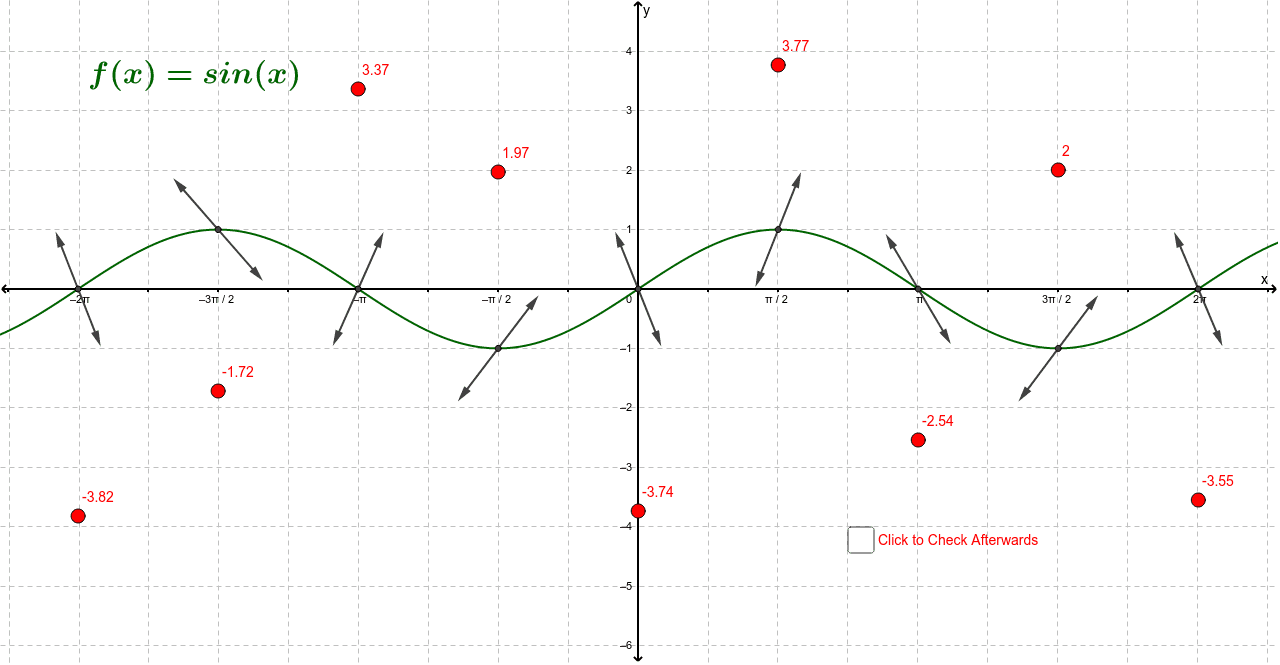
This example demonstrates how students can intuitively discover that the derivative of the sine function y=sin(x) is the cosine function y=cos(x). It involves core math concepts like derivatives, sine and cosine functions, and geometric constructions. The construction uses GeoGebra commands and objects such as Random, RandomElement, Point, Circle, Intersect, and Vector. It is suitable for high school mathematics teaching to help students understand the geometric meaning of derivatives and properties of trigonometric functions.
GeoGebra Commands & Parameters
Random(1, 2) → bRandom(-3, 3) → cRandom(-3, 3) → dRandomElement(list1) → aPoint(vert_A) → ACircle((x(A), g(x(A))), 1) → circle_AIntersect(circle_A, line_A, 1) → A_2Intersect(circle_A, line_A, 2) → A_3Intersect(g, vert_A, (0, 0)) → A_1Vector(A_1, A_3) → u_AVector(A_1, A_2) → v_APoint(vert_B) → BCircle((x(B), g(x(B))), 1) → circle_BIntersect(g, vert_B, (1.5707963267948966, 1)) → B_1Intersect(circle_B, line_B, 1) → B_2Intersect(circle_B, line_B, 2) → B_3Vector(B_1, B_2) → u_BVector(B_1, B_3) → v_BPoint(vert_C) → CIntersect(g, vert_C, (3.141592653589793, 1.2246467991473532E-16)) → C_1Circle((x(C), g(x(C))), 1) → circle_CIntersect(circle_C, line_C, 1) → C_2Intersect(circle_C, line_C, 2) → C_3Vector(C_1, C_3) → u_CVector(C_1, C_2) → v_CPoint(vert_D) → DCircle((x(D), g(x(D))), 1) → circle_DIntersect(g, vert_D, (4.71238898038469, -1)) → D_1Intersect(circle_D, line_D, 1) → D_2Intersect(circle_D, line_D, 2) → D_3Vector(D_1, D_2) → u_DVector(D_1, D_3) → v_DPoint(vert_E) → ECircle((x(E), g(x(E))), 1) → circle_EIntersect(g, vert_E, (6.283185307179586, -2.4492935982947064E-16)) → E_1Intersect(circle_E, line_E, 1) → E_2Intersect(circle_E, line_E, 2) → E_3Vector(E_1, E_2) → u_EVector(E_1, E_3) → v_EPoint(vert_F) → FCircle((x(F), g(x(F))), 1) → circle_FIntersect(g, vert_F, (-1.5707963267948966, -1)) → F_1Intersect(circle_F, line_F, 1) → F_3Intersect(circle_F, line_F, 2) → F_2Vector(F_1, F_3) → u_FVector(F_1, F_2) → v_FPoint(vert_G) → GCircle((x(G), g(x(G))), 1) → circle_GIntersect(g, line_G, (-3.141592653589793, -1.2246467991473532E-16)) → G_1Intersect(circle_G, line_G, 1) → G_2Intersect(circle_G, line_G, 2) → G_3Vector(G_1, G_2) → u_GVector(G_1, G_3) → v_GPoint(vert_H) → HCircle((x(H), g(x(H))), 1) → circle_HIntersect(g, line_H, (-4.71238898038469, 1)) → H_1Intersect(circle_H, line_H, 1) → H_2Intersect(circle_H, line_H, 2) → H_3Vector(H_1, H_2) → u_HVector(H_1, H_3) → v_HPoint(vert_I) → ICircle((x(I), g(x(I))), 1) → circle_IIntersect(circle_I, line_I, 1) → I_2Intersect(circle_I, line_I, 2) → I_3Intersect(g, line_I, (-6.283185307195264, -1.5677880535186782E-11)) → I_1Vector(I_1, I_2) → u_IVector(I_1, I_3) → v_I
AI Drawing Prompt Reference
Draw the graph of the sine function y=sin(x), select multiple random points on the curve, draw circles with radius 1 centered at each point, intersect the circles with tangent lines to the sine curve at two points, and connect the tangent points to the intersection points to form vectors, demonstrating the geometric meaning that the derivative of the sine function is the cosine function with multiple points' vector constructions.
The prompt above was compiled from the original drawing commands and is for reference only.