
Intersection Points: Long or Short?
Loading the math board and drawing, please wait…
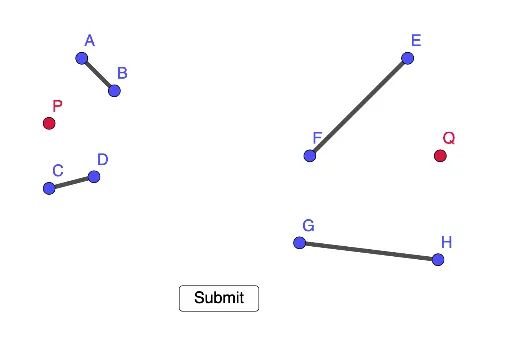
This interactive GeoGebra example explores whether it is easier to infer the location of intersection points when segments are longer or shorter. It demonstrates the relationship between segment length and geometric intuition, involving concepts of line and segment intersection, statistical characteristics such as histograms, and hypothesis testing. The construction uses commands like Segment, Line, and Intersect to create lines and segments, with interactive buttons (button1, button2) and text (text1) to switch between different segment lengths and record observations. Suitable for high school or early college students in geometry, statistics, or mathematical experimentation classes.
GeoGebra Commands & Parameters
Segment(A, B) → fSegment(C, D) → gSegment(E, F) → hSegment(G, H) → iLine(A, B) → jLine(C, D) → kLine(F, E) → lLine(G, H) → mIntersect(l, m) → JIntersect(j, k) → ISegment(P, I) → ppSegment(Q, J) → qq
AI Drawing Prompt Reference
Draw a geometric figure with four segments and four corresponding lines. Two segments are short and two are long, each with endpoints marked by points. The lines pass through the endpoints of these segments, forming two pairs of intersecting lines. Each pair intersects at a point, one on the lines from the short segments and one on the lines from the long segments. Then, from each intersection point, draw a segment to an additional point, creating two auxiliary segments. The figure illustrates how segment length affects the perception of intersection locations.
The prompt above was compiled from the original drawing commands and is for reference only.