
Intersection of Two Parametric Curves via Implicit Curves
Loading the math board and drawing, please wait…
In collections
intersection: surface-surface, curve-curve
intersection: surface-surface, curve-curve
intersection: surface-surface, curve-curve
intersection: surface-surface, curve-curve
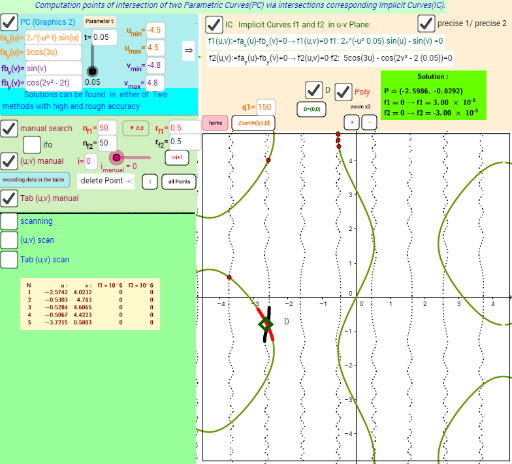
This example demonstrates how to find the intersection points of two parametric curves by solving the corresponding implicit curves. Key math concepts include parametric equations, implicit curves, intersection solving, and geometric relationships. Construction highlights involve GeoGebra commands such as ImplicitCurve, Intersect, PolyLine, Point, PathParameter, etc. Suitable for high school and above students to understand the relationship between parametric and implicit curves and intersection calculations.
GeoGebra Commands & Parameters
ImplicitCurve(f2(x, y)) → bIntersect(Circle[D, r_b], OrthogonalLine[D, Segment[D, ClosestPoint[b, D]]], 1) → Z1_bIntersect(Circle[D, r_b], OrthogonalLine[D, Segment[D, ClosestPoint[b, D]]], 2) → Z2_bImplicitCurve(f1(x, y)) → aIntersect(Circle[D, r_a], OrthogonalLine[D, Segment[D, ClosestPoint[a, D]]], 2) → Z2_aIntersect(Circle[D, r_a], OrthogonalLine[D, Segment[D, ClosestPoint[a, D]]], 1) → Z1_aPolyLine(Zip[ClosestPoint[b, B], B, Z1_b + ((Z2_b - Z1_b) / n_b * Sequence[i, i, 0, n_b])]) → polZbPolyLine(Zip[ClosestPoint[a, B], B, Z1_a + ((Z2_a - Z1_a) / n_a * Sequence[i, i, 0, n_a])]) → polZaElement({Intersect[polZb, polZa]}, 1) → PZPoint(a) → BPathParameter(B) → Pf1BTextfield(Nn) → InputBox4Textfield(e) → InputBox5Textfield(x_{min}) → InputBox6Textfield(x_{max}) → InputBox7Textfield(y_{min}) → InputBox8Textfield(y_{max}) → InputBox9Polygon((x_{min}, y_{min}), (x_{max}, y_{min}), (x_{max}, y_{max}), (x_{min}, y_{max})) → poly1, g1_s, g2_s, g3_s, s4_sTextfield(α) → InputBox2Length(lr1) → llr1Length(lf2) → llf2Textfield(r) → InputBox16CurveCartesian(fa_x(u), fa_y(u), u, x_{min}, x_{max}) → a_cCurveCartesian(fb_x(v), fb_y(v), v, y_{min}, y_{max}) → b_cElement(lr1, i_{manual}) → C_tElement(lr2_bscan, f) → B_{xy}Length(lf1) → llf1Textfield(fa_x) → InputBox17Textfield(fa_y) → InputBox18Textfield(fb_x) → InputBox19Textfield(fb_y) → InputBox20Textfield(n_a) → InputBox21Textfield(n_b) → InputBox22Textfield(r_a) → InputBox23Textfield(q) → InputBox24PolyLine(Z1_a + ((Z2_a - Z1_a) / n_a * Sequence[i, i, 0, n_a])) → poly2_aaPolyLine(Z1_b + ((Z2_b - Z1_b) / n_b * Sequence[i, i, 0, n_b])) → poly2_bbPoint(poly2_aa, e1) → R_aPoint(poly2_bb, e2) → R_bClosestPoint(a, R_a) → R'_aClosestPoint(b, R_b) → R'_bLength(R'_a - R'_b) → dmaxmins2If(Defined[PZ], If[fza2 < fzb2, (f1za2, f2za2), (f1zb2, f2zb2)], (NaN, NaN)) → errorz2If(Defined[PZ], If[fza2 < fzb2, R'_a, R'_b], (NaN, NaN)) → Pz2If(ca, PZ, Pz2) → PZ0If(ca, f11, x(errorz2)) → f110If(ca, f22, y(errorz2)) → f220Length(lZ1_a) → lälZ1_aLength(lZ1_b) → lälZ1_bElement(listxyres, f) → B_tTextfield(r_b) → InputBox13Textfield(α) → InputBox11Element(roots0, f) → ASequence((fa_x(x(Element[lr1, i])), fa_y(x(Element[lr1, i]))), i, 1, llr1) → lr2_aSequence((fb_x(y(Element[lr1, i])), fb_y(y(Element[lr1, i]))), i, 1, llr1) → lr2_bZip(((abs(x(a - b) / x(a)) * 100), (abs(y(a - b) / y(a)) * 100)), a, lr2_a, b, lr2_b) → lr2Element(lr2_a, i_{manual}) → Cxy_tTableText({Join[{{"N"}, Sequence[i, i, 1, Length[roots0]]}], Join[{{""}, Sequence["→", i, 1, f]}], Join[{{" u:"}, x(roots0)}], Join[{{" v:"}, y(roots0)}], Join[{{"f1*10^-6"}, lf1_{Pr}2}], Join[{{"f2* 10^-6"}, lf2_{Pr}2}]}, "vr") → Text2TableText({Join[{{"N"}, Sequence[i, i, 1, llr1]}], Join[{{""}, Sequence["→", i, 1, i_{manual}]}], Join[{{"u:"}, x(lr1)}], Join[{{"v:"}, y(lr1)}], Join[{{"f1* 10^-6"}, lf1}], Join[{{"f2* 10^-6"}, lf2}]}, "vr") → text8Textfield(t) → InputBox1Textfield(f) → InputBox3TableText({Join[{{"N"}, Sequence[i, i, 1, Length[roots0]]}], Join[{{""}, Sequence["→", i, 1, f]}], Join[{{"(x,y)_a"}, lr2_ascan}], Join[{{"(x,y)_b"}, lr2_bscan}], Join[{{"(δx,δy) %"}, lr2scan}]}, "vr") → text12aTableText({Join[{{"N"}, Sequence[i, i, 1, llr1]}], Join[{{""}, Sequence["→", i, 1, i_{manual}]}], Join[{{"(x,y)_a"}, lr2_a}], Join[{{"(x,y)_b"}, lr2_b}], Join[{{"(δx,δy) %"}, lr2}]}, "vr") → text12rTextfield(i_{manual}) → Eingabefeld1Textfield(q2) → Eingabefeld2ImplicitCurve(f01(x, y)) → c
AI Drawing Prompt Reference
Draw the intersection points of two parametric curves. First, plot the two parametric curves and convert them into implicit curves. Then, find the intersections of these implicit curves with the vertical lines passing through points on the parametric curves. Next, use these intersection points to draw approximated line segments of the parametric curves and find the intersection of these segments. Finally, determine the final intersection point based on the given parameters and conditions.
The prompt above was compiled from the original drawing commands and is for reference only.