
Intersection-Based Construction of the Viviani Curve
Loading the math board and drawing, please wait…
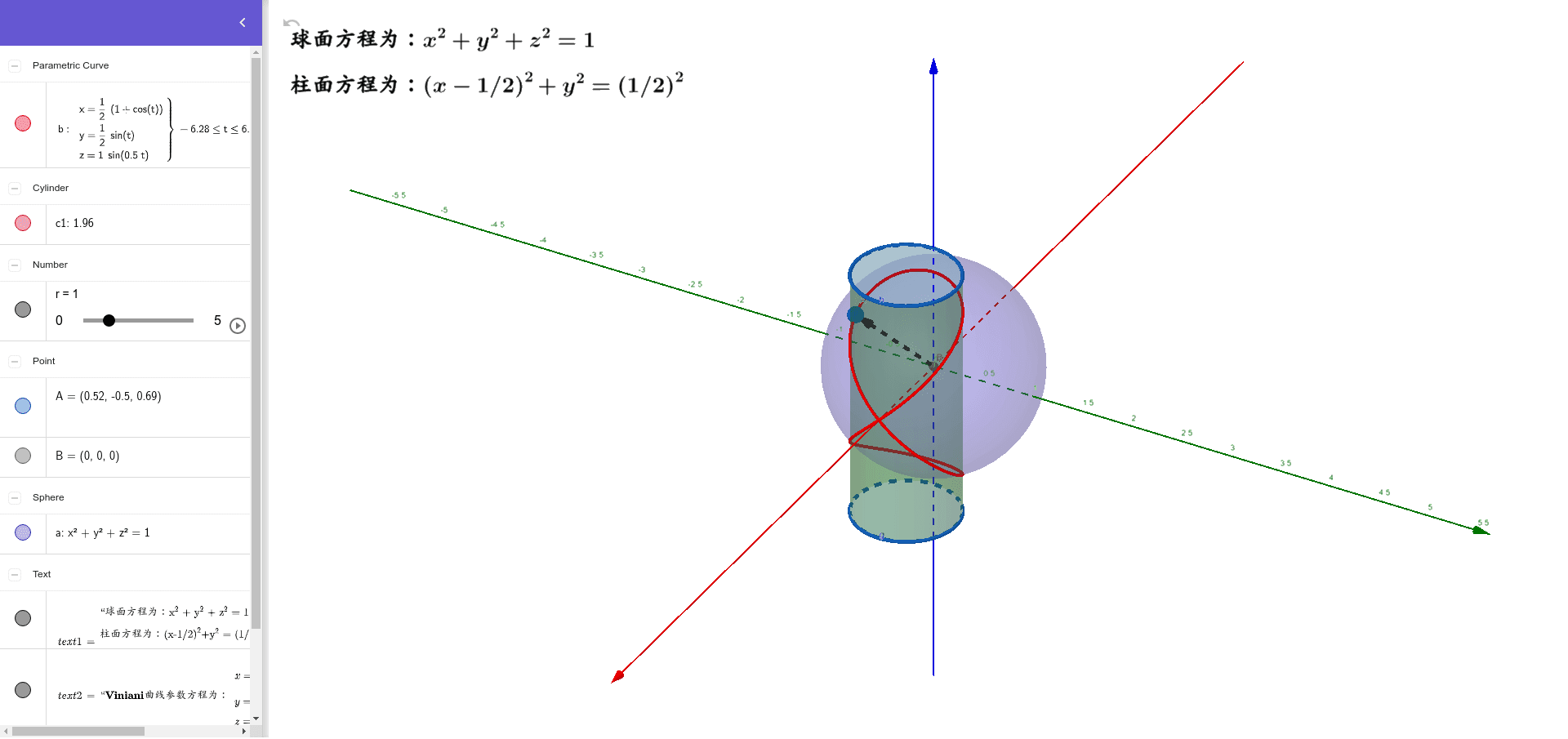
This GeoGebra example demonstrates how the Viviani curve arises as an intersection (a space locus) between standard 3D surfaces such as a sphere and a cylinder/rotation body. By adjusting an underlying parameter, students can observe how the intersection curve behaves and connect the geometry of the solid with the resulting planar/Cartesian description. Key math concepts include solid-geometry surface intersection, locus/trajectory thinking in 3D, vector representation for defining directions and constructing reference points, and the curve’s relationship to trigonometric expressions (e.g., cosine-type parameters) alongside the broader calculus context (useful for later discussion of tangents/derivatives). Construction highlights: Cylinder and Sphere are used to build the two surfaces (e.g., objects r, c1, along with g, h, i), Intersect computes their intersection curve, CurveCartesian provides the Cartesian parametric/graph form of the resulting curve, and Point/Vector create essential points and direction vectors (objects A, B, u, a, b). Text labels (text1, text2) help communicate the parameters and geometric roles. Suitable for high-school advanced geometry through early university calculus/precalculus learners, especially for interactive lessons on 3D-to-curve connections.
GeoGebra Commands & Parameters
Cylinder((r / 2, 0, -1.25), (r / 2, 0, 1.25), r / 2) → c1, g, h, iSphere((0, 0, 0), r) → aCurveCartesian((r / 2 * (1 + cos(t))), (r / 2 * sin(t)), (r * sin((0.5 * t))), t, -6.28319, 6.28319) → bPoint(b) → AIntersect(xAxis, zAxis) → BVector(B, A) → u
AI Drawing Prompt Reference
Draw the Viviani curve formed by the intersection of a sphere and a cylinder, showcasing the locus of intersection between 3D surfaces. Adjust the parameters to observe how the intersection curve behaves, linking solid geometry to its planar description. Include the sphere, cylinder, their intersection curve, and essential points and vectors for defining directions and reference points. Construct the sphere and cylinder first, then find their intersection, and finally mark key positions and directions with points and vectors, adding text to explain parameters and geometric roles.
The prompt above was compiled from the original drawing commands and is for reference only.