
Intersecting Cylinders by Chip Rollinson
Loading the math board and drawing, please wait…
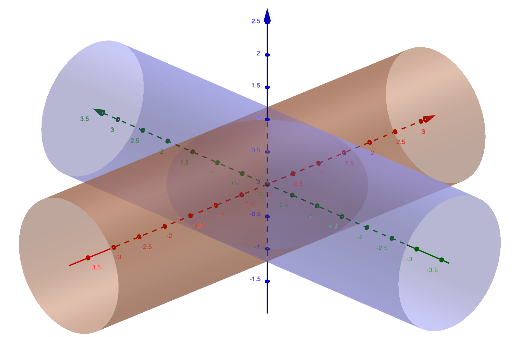
This example demonstrates the complex three-dimensional shape formed by the intersection of two cylinders. It involves core mathematical concepts such as solid geometry, integral calculus, limits, translation, and matrix transformations. The construction uses GeoGebra commands like Cylinder and Surface, along with objects A, B, C, D, a, c, d, b, e, f, g, h, r, i, i', j, k, E, F, G, H. It is suitable for high school and above students studying solid geometry, calculus, and 3D graphical computer-aided design.
GeoGebra Commands & Parameters
Cylinder(A, B, 1) → a, c, d, bCylinder(C, D, 1) → e, f, g, hSurface((u * sqrt(1 - r^(2))), (v * sqrt(1 - r^(2))), r, u, -1, 1, v, -1, 1) → i
AI Drawing Prompt Reference
Draw two cylinders of radius 1 with perpendicular axes intersecting at a common center. The first cylinder extends horizontally, the second vertically, crossing to form a complex interpenetrating solid. In the intersection region, depict a saddle-like parametric surface defined by two orthogonal square-root functions, each scaled by a factor, with parameters ranging from -1 to 1. This surface smoothly bridges the two cylinders, highlighting the spatial intersection curves and the transition region. The overall shape illustrates the three-dimensional intersection volume, suitable for studying solid geometry and integral calculus.
The prompt above was compiled from the original drawing commands and is for reference only.